Tips for Managing Event Photo Booth Lines
Table of Contents
- Why Photo Booth Line Management Matters
- Choose the Right Photo Booth Event Layout
- Control Photo Booth Session Length
- Assign a Dedicated Photo Booth Attendant
- Use Clear Photo Booth Queue Signage and Rules
- Implement a Sign-Up Sheet or Timed Turns System
- Set Guest Expectations and Booth Etiquette
- Plan for Peak Demand and Contingencies
- Measure and Adjust Queue Performance
- Frequently Asked Questions
Last Updated: October 18, 2026
Why Photo Booth Line Management Matters
When it comes to tips for managing event photo booth lines, the stakes are high: long lines kill the vibe at any event. Guests get frustrated. They skip the photo booth entirely. Your event feels less interactive and memorable.
The real problem isn't the photo booth itself. It's that most event planners don't think through how guests will actually move through the space. A booth with no line strategy becomes a bottleneck. People bunch up. Wait times climb. The experience that should be fun becomes a chore.
Managing tips for managing event photo booth lines well changes everything. When guests move through quickly and smoothly, they actually use the booth. They share photos. They enjoy themselves. The booth becomes a highlight instead of a pain point.
At Photobooth NYC, we run 100+ events a year, from 50 to 1,200 guests. The difference between an event where the photo booth runs smoothly and one where it creates chaos always comes down to planning. The booth itself is just equipment. How you organize the space, manage flow, and set expectations, that's what makes it work.
Choose the Right Photo Booth Event Layout
Your booth's location and the surrounding space determine whether guests flow naturally or get stuck. This is the first decision that affects everything else.
Strategic Booth Placement and Circulation
Place your photo booth near an entrance or main circulation area, not in a corner. Guests should be able to see it and reach it without disrupting the main event flow. If the booth is hidden, people won't use it. If it's in the middle of traffic, it creates congestion.
Think about how guests move through your venue:
- Position the booth where foot traffic naturally passes
- Keep the booth visible from key gathering areas
- Leave clear pathways on both sides so people don't get trapped
- Avoid placing it directly in front of exits or restrooms
The booth itself needs breathing room. Allow at least 6-8 feet of clear space in front for the queue. If guests are packed too tight, they'll abandon the line.
Managing Guest Flow Around the Booth
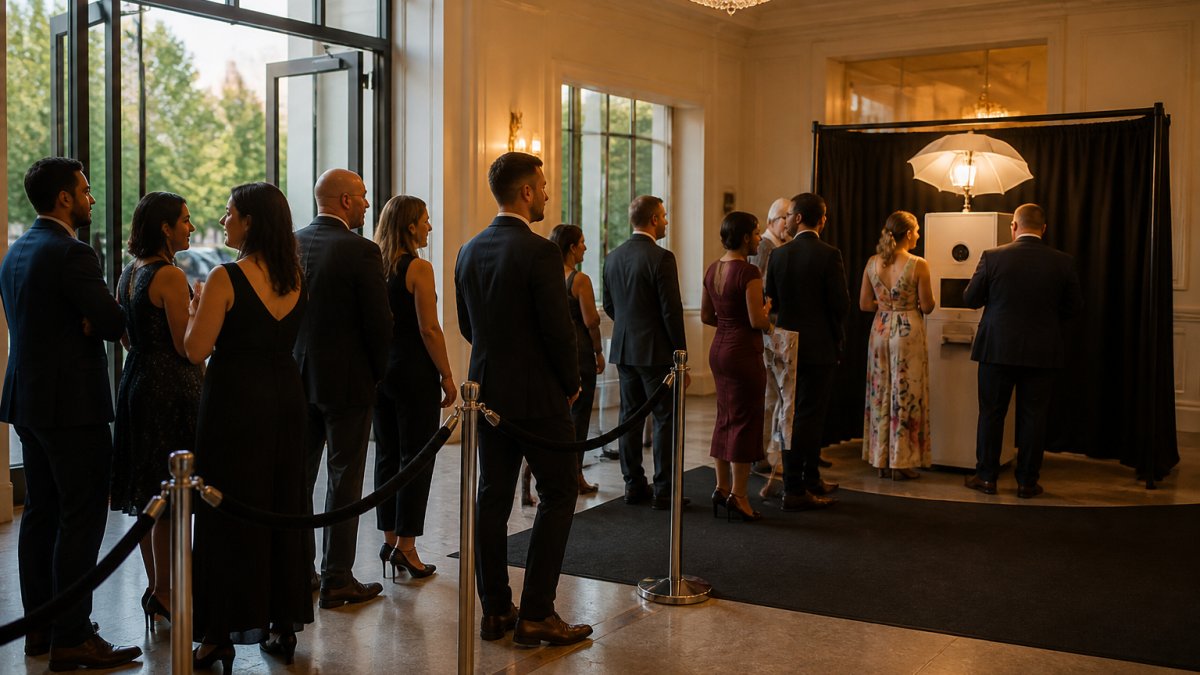
Create a defined queue area that doesn't block other activities. Use rope barriers, tape on the floor, or signage to show guests exactly where to line up. A clear queue feels organized. A chaotic crowd feels like a mistake.
Direct foot traffic in one direction:
- Queue starts at one point
- Guests move forward through the booth
- They exit on the other side
- No backtracking or confusion
If your venue has multiple rooms or levels, consider whether guests can easily find the booth. A hidden photo booth gets half the usage. A visible, accessible booth gets used all night.
Control Photo Booth Session Length
How long each group spends in the booth directly controls how many people can go through. Longer sessions mean longer waits. Shorter sessions keep lines moving.
**** This gives guests time to take multiple photos, try different poses, and have fun, without letting them endlessly fidget and retake shots.
Set a timer. Make it visible. When time's up, move to the next group. Guests understand the booth has a line. Clear limits actually improve the experience because no one feels like they're being rushed unfairly.
Limit the number of shots per session:
- 3-5 photos per group works well
- One or two outfit or prop changes is fine
- No endless retakes of the same pose
- Move forward on schedule
A trained photo booth attendant enforces this naturally. They keep things moving without making guests feel bad. An unattended booth has no one to manage pace, so lines back up fast.
Assign a Dedicated Photo Booth Attendant
This is the single biggest factor in line management. An attendant keeps things running smoothly all night.
Core Attendant Responsibilities
A good attendant does more than just press buttons. They:
- Greet guests and explain how the booth works
- Keep the line moving on schedule
- Manage props and help guests pose
- Monitor printing and fix jams immediately
- Deliver photos to guests (prints and digital)
- Keep the booth clean and organized
- Troubleshoot technical issues on the spot
The attendant is your line manager, your operator, and your customer service rep all at once. They're the reason the booth runs well instead of creating chaos.
At Photobooth NYC, our attendants have live event experience. They understand venue logistics and tight timelines. They set up and strike the booth within strict load-in windows. Whether you're planning a Corporate Event Photo Booth Rental, a Wedding Photo Booth Rental NYC, or a Branded Photo Booth for Brand Activations, our trained attendants keep the line moving without making guests feel rushed.
How an Attendant Keeps Lines Moving
An attendant prevents the two biggest line killers: technical delays and slow pacing.
When the printer jams, an attendant fixes it in seconds. Guests don't wait 10 minutes wondering what's wrong. When a guest doesn't understand how to pose, the attendant shows them. When someone wants to take 20 photos, the attendant gently moves them along.
The attendant also manages the queue itself:
- They tell guests how long the wait is
- They keep people from cutting in line
- They move groups through on time
- They handle any guest complaints or confusion
Without an attendant, the booth becomes a self-service free-for-all. Some guests hog it. Others can't figure out how it works. The line gets longer and angrier.
Use Clear Photo Booth Queue Signage and Rules
Guests can't follow rules they don't know. Make your expectations obvious before they get in line.
Post a simple sign at the entrance to the queue:
- "Average wait time: [X] minutes"
- "Session length: 90 seconds"
- "One or two outfit changes welcome"
- "Photos print instantly and go to your phone"
This sets expectations. Guests know what they're signing up for. They're less likely to get frustrated.
Also explain how to get their photos:
- Prints come out automatically
- Scan the QR code for digital copies
- Check your email for the online gallery
Clear signage reduces confusion and keeps the line moving. Guests don't need to ask questions. They already know what to do.
Implement a Sign-Up Sheet or Timed Turns System
For smaller events or VIP groups, a sign-up sheet works well. For larger events, timed turns prevent long waits.
Sign-up sheets work best when:
- Your event has fewer than 200 guests
- You want to give certain groups priority (wedding party, executives)
- You're not worried about strict timing
Pass around a clipboard. Guests write their names. You call them in order. Simple and flexible.
Timed turns work best when:
- Your event has 200+ guests
- You want to guarantee everyone gets a turn
- You need predictable line management
Assign 15-minute time slots. Tell guests, "Your photo booth time is 7:15-7:30 PM." They know exactly when to show up. No one waits in line for hours. Everyone gets a fair chance.
A hybrid approach also works: give VIP groups reserved slots, and open other slots on a first-come, first-served basis.
Set Guest Expectations and Booth Etiquette
Tell guests upfront what the photo booth experience is like. Include it in your event invitation or program.
Explain:
- The booth is available from [start time] to [end time]
- Sessions are about 90 seconds
- Everyone gets a turn (or mention if it's first-come, first-served)
- Photos print instantly and are sent to your phone
- There's a line, so come back if it's too long
When guests know what to expect, they cooperate. They understand why the line moves at a certain pace. They don't feel like they're being treated unfairly.
Also set etiquette rules:
- One group at a time
- Respect the time limit
- Have fun, but don't block other guests
- Clean up props when you're done
Most guests will follow these naturally if you explain them clearly.
Plan for Peak Demand and Contingencies
Most line problems are predictable. If you know when the rush is coming and what you'll do when it hits, the queue bends instead of breaking.
Map your peak windows before the event
Build a simple timeline of the night and mark the windows when the booth will be slammed. A common pattern:
- Cocktail hour, when guests arrive and mingle before seating
- The 20-30 minutes right after dinner service ends
- The window right after a keynote, award presentation, or first dance
- The last 45 minutes, when guests realize the booth is about to close
Put those windows on the attendant's run sheet. A trained attendant who knows the 8:40 PM surge is coming will have props restocked, paper loaded, and the queue organized before it starts, instead of scrambling mid-rush.
Run the throughput math so the surge doesn't surprise you
Estimate how many groups the booth can serve per hour and compare it to how many guests are likely to want a turn in each peak window. A session plus roughly 30 seconds of reset and print handling means about 30 groups per hour in steady operation. If 300 guests are likely to want photos and most of them arrive in a two-hour window, you're looking at a queue that will back up unless you spread demand.
Three levers spread the load:
- Open the booth earlier, during cocktail hour, so the first wave clears before dinner
- Publish the booth hours on signage and in the program so guests self-schedule
- Use timed slots (see the sign-up section) for the busiest windows
Have a written surge procedure
When the line crosses a threshold you set in advance, say 12-15 groups deep, the attendant switches modes:
- Announce the current wait out loud and on the sign so guests can decide whether to stay
- Tighten session pacing to the lower end of the range and skip optional retakes
- Hand out numbered tickets so guests can step away and come back instead of standing in place
- Point guests to the sharing station or a second photo moment if one exists
Decide the threshold and the steps before the event. Improvising mid-rush is how lines stall.
Plan for the things that actually go wrong
A short contingency list the attendant works from:
- Printer issue: pause the queue, tell guests the wait, keep taking digital sessions if prints are temporarily unavailable, and hand out prints or digital links as soon as it's resolved
- Network or upload delay: keep shooting, queue the digital delivery, and confirm to guests that their photos will arrive shortly
- Backdrop or prop damage: swap in what's on hand and keep the line moving
- Guest behavior problem: the attendant steps in early, before it affects the queue
Build in venue logistics buffers
In Manhattan, Brooklyn, Queens, Staten Island, and across Nassau and Suffolk, load-in and strike windows are often tight, and venues frequently require a certificate of insurance and a booked freight elevator or loading dock slot. Build those into the run of show so setup finishes before doors, not during cocktail hour. A booth that's still being assembled when guests arrive starts the night with a line.
Measure and Adjust Queue Performance
You can't improve next year's line if you don't know how this year's performed. A few simple counts taken during the event turn guesswork into planning.
What to track (and how to capture it)
You don't need software. A clipboard and a phone timer get you most of the way:
- Sessions completed: the attendant tallies each group as they finish. This is your throughput number.
- Average session length: time a sample of 10-15 groups from entry to exit. If the average drifts past your target, pacing is slipping.
- Peak queue depth: note the longest line and when it happened. Compare it to the peak windows you predicted.
- Average wait: ask a handful of guests as they leave how long they waited, or have the attendant estimate from queue depth and throughput.
- Abandonment: count guests who joined the line and left before their turn. A rising number means the wait felt too long, even if it wasn't.
- Issues log: one line per problem (printer, network, prop, guest behavior) with the time and how long it took to resolve.
Turn the numbers into decisions
After the event, compare sessions completed against guest count. If a small share of guests used the booth, the bottleneck was probably visibility or timing, not session length. If most guests used it but waits were long, the bottleneck was throughput or demand concentration.
Use these rules of thumb:
- Long waits concentrated in one window: open the booth earlier or add timed slots for that window
- Waits spread evenly all night: shorten sessions or extend booth hours
- High abandonment: improve signage and wait-time communication before changing anything else
- Repeated technical issues: flag them for the vendor before your next event so they're addressed in setup
Set a target before the event
Decide in advance what a good night looks like, for example: most guests who want a photo get one, average wait stays under a set number of minutes, and abandonment stays low. Write the target on the run sheet so the attendant knows what to protect when the rush hits.
Debrief while it's fresh
Within a day or two of the event, sit down with the attendant's notes and your own observations. Note what worked, what you'd change, and the one or two numbers that tell the story. Carry those into your next event plan. Over a few events, you'll have a realistic picture of how your guests use the booth and how to staff and schedule it.
Photo booth line management comes down to three things: a clear layout, a trained attendant, and realistic throughput planning. Get those right, and your guests move through quickly, have fun, and actually use the booth. The experience becomes a highlight instead of a headache.
Ready to plan your event? Photobooth NYC offers everything from the Standard Photo Booth Package to the Premium Photo Booth Package with pro camera and studio lighting, plus the Signature Photo Booth Package with dual-printer and oversized prints. Every package includes a trained, fully attended operator all night. Photobooth NYC booths range from $1,495 to $5,250 per booth depending on package, hours and date, and every fee is quoted upfront on the call. Check availability for your date and get a quote tailored to your event.
Frequently Asked Questions
How long should each photo booth session take?
Each guest group should spend 2-4 minutes in the booth. This includes posing, taking multiple shots, and reviewing images before printing. A trained attendant can enforce timing by setting a timer or gently moving groups forward. Shorter sessions keep lines moving; longer sessions frustrate waiting guests. Adjust based on your event size and total booth hours available.
Where should you place a photo booth to prevent crowding?
Position the booth near an entrance or high-traffic area, but not directly blocking the main flow of guests. Ensure clear entry and exit paths so people don't bottleneck. Avoid placing it in a corner or dead-end room where queues trap guests. Leave at least 6-8 feet of space in front of the booth for the line, and mark the queue boundary with rope or signage. A professional attendant will manage the space and keep the line organized.
How can a photo booth attendant help manage lines?
A trained attendant controls session timing, directs guests through the booth, manages the queue, answers questions, and keeps energy high. They greet waiting guests, explain the process, enforce group size limits, and ensure prints and digital files are delivered smoothly. An attendant also troubleshoots technical issues on the spot, so guests don't wait for remote support. This hands-on presence is essential for smooth line flow at any event.
What should guests do while waiting for the photo booth?
Set up a nearby activity or viewing station where waiting guests can see photos from earlier groups, browse props, or enjoy refreshments. Some events use a digital gallery or QR code to let guests view and share photos from their phones while they wait. Clear signage explaining the wait time and booth rules keeps expectations realistic. Engaged guests wait more patiently than bored ones.
