How to Choose a Wedding Photo Booth: 2026 Guide
Table of Contents
- Why a Photo Booth Matters for Your Wedding
- Open Air vs. Enclosed Photo Booth: Which Fits Your Event
- Key Features to Look for When You Choose a Photo Booth
- How Long to Rent a Photo Booth for Your Wedding
- Understanding the Average Cost of a Wedding Photo Booth
- On-Site Attendant vs. DIY Setup: What You Need to Know
- Questions to Ask Photo Booth Vendors Before Booking
- Venue Layout and Space Requirements
- Common Mistakes to Avoid When Choosing a Photo Booth
- Accessibility Considerations for All Your Guests
- Common Mistakes to Avoid When Choosing a Photo Booth
- Frequently Asked Questions
Last Updated: September 27, 2026
Why a Photo Booth Matters for Your Wedding
When you choose wedding photo booth services, you transform your wedding reception into an interactive entertainment hub that captures candid moments your professional photographer might miss. Unlike static posed portraits, a photo booth creates genuine interactions between guests, produces instant tangible keepsakes, and generates digital content your guests can share immediately on social media. Photo booths aren't just entertainment, they're a strategic investment in guest engagement and post-wedding memories that guests actually want to keep and share.
The real value emerges over time. Guests spend 3-5 minutes per visit creating photos with props, backdrops, and custom branding. That sustained engagement keeps your reception energized during natural lulls, cocktail hour, between courses, or while waiting for the band to set up. More importantly, the digital gallery and instant prints become conversation starters long after the wedding ends. Guests text the photos to friends, post them online with your custom hashtag, and the booth's digital archive becomes a searchable record of your celebration that you control and can access years later.
When you choose a wedding photo booth, you're making decisions that affect guest flow, aesthetic continuity, technical reliability, and long-term value. The wrong choice creates bottlenecks, clashing visuals, or equipment failures that derail the evening. The right choice amplifies your event, aligns with your venue and décor, and delivers memories in formats your guests actually use.
Open Air vs. Enclosed Photo Booth: Which Fits Your Event
The choice between an open-air booth and an enclosed booth shapes your entire photo booth experience. This decision affects space requirements, aesthetic integration, print quality, guest experience, and operational flow.
Open-Air Booth Advantages and Best Use Cases
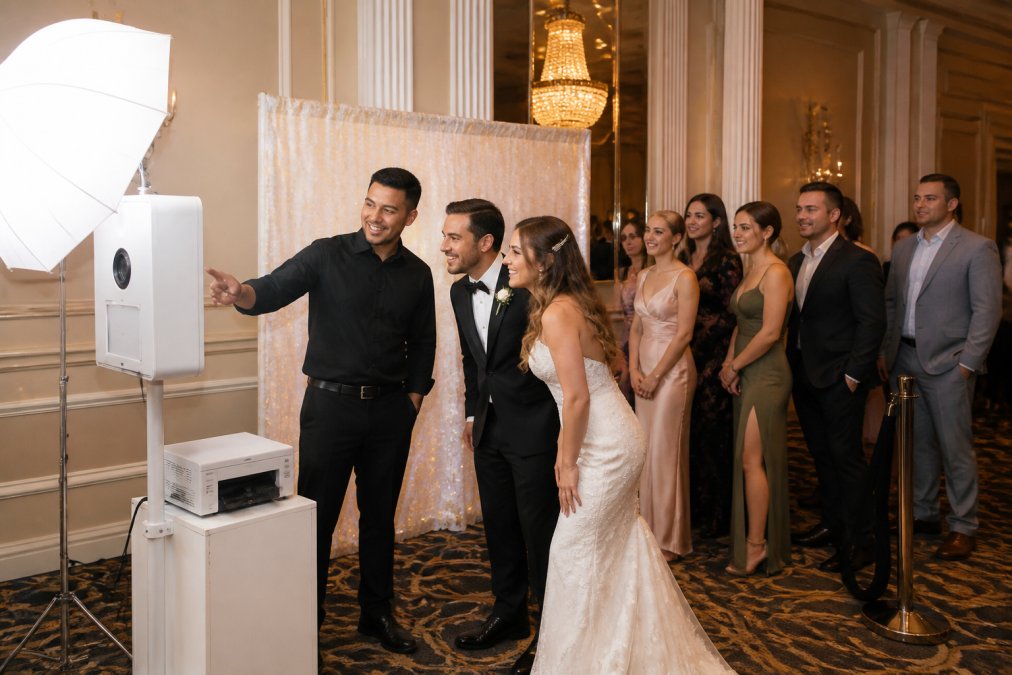
An open-air booth is a freestanding frame or structure with a backdrop, camera, and lighting positioned in front of the guests. The camera and printer sit exposed, and guests stand or sit in front of the setup while photos are taken. This format prioritizes speed, social engagement, and seamless integration into your reception space.
Open-air booths excel at high-volume events because guests move through quickly, typically 2-3 minutes per group. The open design means no enclosed space to wait in, no door to open and close, and no claustrophobic feeling. Guests see the booth operating, understand the process immediately, and feel comfortable bringing friends or family members into the shot. For weddings with 150+ guests, open-air booths prevent the bottleneck problems that enclosed booths sometimes create.
Aesthetically, open-air booths integrate seamlessly into your reception décor. You control the backdrop entirely, custom-branded prints, elegant fabric, floral installations, or minimalist designs that complement your color palette. Photobooth NYC offers custom color grading to match any event aesthetic, so the photos themselves reflect your wedding's visual identity. The booth becomes part of your décor rather than an intrusive box in the corner.
Open-air booths work best for: cocktail receptions, garden weddings, outdoor venues, high-energy celebrations, events where guest flow and speed matter more than privacy, and situations where your venue has limited space.
Enclosed Booth Advantages and Best Use Cases
An enclosed booth is a self-contained cabinet or pod where guests step inside, close a door or curtain, and take photos in a private space. The camera, lighting, and printer are built into the unit. This format prioritizes privacy, controlled lighting, and a contained footprint.
Enclosed booths appeal to guests who feel self-conscious about being photographed in front of the entire reception. The privacy of an enclosed space makes some guests more willing to participate, try bold poses, or be silly, they're not performing for the crowd. The controlled interior lighting ensures consistent photo quality regardless of your venue's ambient lighting, which matters in dimly lit ballrooms or venues with uneven illumination.
Enclosed booths require less floor space than open-air setups because the entire mechanism is vertical rather than spreading outward. If your venue is tight on square footage, an enclosed booth takes up roughly the footprint of a phone booth or small closet. However, the tradeoff is that guests must enter and exit individually or in very small groups, which slows throughput. At a large wedding, enclosed booths can create wait times that frustrate guests and reduce overall participation.
Enclosed booths work best for: intimate weddings, indoor venues with limited space, events where guest privacy is a priority, formal affairs where you want to control the photo environment, and situations where your venue lighting is challenging. They're also ideal for corporate events where guests may feel more reserved about public participation.
Key Features to Look for When You Choose a Photo Booth
When you choose wedding photo booth vendors, you're evaluating technical capabilities, output quality, customization options, and user experience. The best booth balances professional-grade quality with guest-friendly simplicity.
Camera Quality and Lighting Setup
The camera and lighting system determines whether your photos look professional or amateurish. A DSLR camera with studio lighting (ring lights or key lights) produces sharp, well-exposed images with flattering skin tones. A smartphone or tablet camera produces softer, more casual images suitable for social sharing but less suitable for printing or archival purposes.
Studio lighting is non-negotiable for evening receptions or venues with poor ambient lighting. Without proper lighting, photos come out dark, grainy, or with harsh shadows. A professional photo booth uses a combination of key lights and fill lights to create dimensional, flattering illumination regardless of your venue's existing lighting. Photobooth NYC's premium package includes professional-grade camera systems with studio lighting specifically designed for wedding environments.
Ask potential vendors about their camera specifications, lighting setup, and how they adjust for different venue conditions. Request sample photos taken in lighting conditions similar to your venue. Poor lighting is one of the most common complaints about budget photo booths, it's also one of the easiest problems to prevent by choosing the right equipment upfront.
Print Quality and Template Design
Instant prints are a tangible takeaway guests value. Print quality depends on the printer type and ink quality. Dye-sublimation printers produce lab-quality prints with vibrant colors and longevity. Inkjet printers are cheaper but produce lower-quality prints that fade over time.
Template design affects how professional your prints look. A well-designed template incorporates your wedding colors, date, names, and custom branding without overwhelming the photo itself. Poor templates look cluttered, use clashing fonts, or leave too little space for the actual image. Ask vendors to show you template options and confirm you can customize them to match your wedding aesthetic.
The number of photos per strip matters too. Standard 2x8 strips are compact and easy to keep as mementos. Larger 6x8 prints allow more generous photo sizing but take up more space. Dual-printer setups can produce both formats simultaneously, giving guests options.
Social Media Sharing and Digital Galleries
Modern photo booths let guests share photos instantly via text, email, or QR code. This real-time sharing extends your wedding's social reach, guests post photos with your custom hashtag, and your wedding appears across their social networks within minutes of the event.
A post-event digital gallery lets you access all booth photos after your wedding. This becomes your searchable archive of candid moments, guest interactions, and décor details. The gallery should be password-protected so only invited guests can access it, and you should have permanent ownership of the photos.
Ask vendors about their digital sharing capabilities: Can guests share to Instagram directly? Do you get a branded QR code for your hashtag? Is the post-event gallery included in the rental, or is it an add-on? How long is the gallery accessible after your wedding?
Customization and Branding Options
Your photo booth should reflect your wedding's visual identity. Custom overlays, branded templates, and color-graded images ensure the booth feels integrated into your celebration, not like a generic rental that could appear at any event.
Overlays are digital graphics applied to photos, your names, wedding date, custom illustrations, or your venue name. Branded templates incorporate your colors and design elements into the print layout. Color grading adjusts the overall tone and saturation of photos to match your wedding's aesthetic (warm and romantic, cool and modern, vibrant and bold, etc.).
Photobooth NYC specializes in custom color grading and branded templates that align with any event aesthetic or brand palette. When you choose a photo booth, confirm that customization is included in the package, not an expensive add-on, and that the vendor can deliver samples matching your specific requests before your event.
How Long to Rent a Photo Booth for Your Wedding
The rental duration depends on your reception timeline, guest count, and how you want to use the booth. Most weddings rent a booth for 3-5 hours, covering the cocktail hour through the end of dancing.
A typical timeline: booth arrives 30-45 minutes before guests enter (setup time), operates during cocktail hour and reception, and stays active until 30-60 minutes before your reception ends. This timing captures the highest-energy moments when guests are most likely to participate, early in the evening when they're fresh, and during dancing when the mood is celebratory.
For a 4-hour rental covering cocktail hour through late dancing, most guests get 1-2 opportunities to visit the booth. Larger weddings may benefit from extended rentals or dual booths to ensure everyone who wants photos gets a chance without excessive wait times.
Shorter rentals (2-3 hours) work for smaller intimate weddings or if you want the booth only during specific periods. Longer rentals (6+ hours) suit all-day celebrations or multi-event days where the booth operates during ceremonies, receptions, and after-parties.
Discuss rental duration with your vendor and confirm what's included: setup time, breakdown time, and whether you're charged by the hour or as a flat package.
Understanding the Average Cost of a Wedding Photo Booth
Photo booth pricing varies widely based on equipment quality, rental duration, customization, and vendor experience. Pricing depends on the specific package you choose, your event date, guest count, and customization requirements.
On-Site Attendant vs. DIY Setup: What You Need to Know
This decision affects photo quality, guest experience, troubleshooting capability, and your stress level on the day of your wedding.
Questions to Ask Photo Booth Vendors Before Booking
Before committing to a vendor, ask specific questions that reveal their reliability, professionalism, legal compliance, and ability to deliver on promises. The strongest vendors are transparent about what's included, communicate clearly about logistics, and operate with proper insurance and data protection.
Insurance and Liability Coverage
Professional photo booth vendors carry general liability insurance that protects you if someone is injured by the booth or if equipment damages your venue. This is non-negotiable.
Ask:
- Are you insured? What's your general liability coverage limit?
- Can you provide proof of insurance before my event?
- Does your insurance cover equipment damage to my venue?
- Am I named as an additional insured on your policy?
Data Privacy and Photo Ownership
The photo booth captures guest faces, and potentially collects personal information (email addresses, phone numbers) for digital gallery access or social sharing. Data privacy matters legally and ethically.
Ask:
- Who owns the photos after the event, me or you?
- Can guests opt out of the digital gallery?
- How long do you retain photos after my event?
- Is the post-event gallery password-protected?
- What's your data retention and deletion policy?
- Do you use guest data (emails, phone numbers) for marketing purposes?
- Are photos stored on secure servers with encryption?
- What happens to photos if your company goes out of business?
Equipment Reliability and Backup Plans
Equipment fails. Printers jam. Cameras malfunction. Software crashes. Professional vendors have backup plans; budget vendors often don't.
Ask:
- What happens if the printer jams during my event? How quickly can you fix it?
- What's your backup plan if the camera fails?
- Do you carry backup equipment on-site?
- How is your equipment maintained and serviced?
- When was your camera last professionally serviced?
- How often do you replace printer components?
- What's your troubleshooting process if something goes wrong?
- Have you experienced equipment failures at recent events, and how did you handle them?
Attendant Experience and Qualifications
The attendant's experience directly affects photo quality and guest experience.
Ask:
- How many weddings has this attendant worked?
- What's their experience with guest management and troubleshooting?
- Are they trained in equipment repair?
- Will the same attendant work my event, or could it be someone different?
- What's your process if the scheduled attendant becomes unavailable?
- Can the attendant assist guests with accessibility needs (mobility, hearing, vision)?
Customization, Branding, and Samples
Customization details should be confirmed in writing before booking to prevent last-minute surprises.
Ask:
- What customization options are included in your package (overlay design, template, color grading)?
- What customization costs extra?
- Can you provide sample photos with my exact custom overlay, template, and color grading applied?
- How far in advance do you need my branding materials?
- What if I want to change the design after booking?
- Can you match my wedding colors and aesthetic?
Cancellation, Rescheduling, and Refund Policies
Life happens. Confirm the vendor's policies if you need to reschedule or cancel.
Ask:
- What's your cancellation policy? How much notice do I need to provide?
- If I reschedule to a different date, is there a rescheduling fee?
- What's your refund policy if I cancel?
- What happens if you cancel due to equipment failure or unavailability?
- Are there any non-refundable deposits?
- What's covered if weather forces an outdoor event indoors?
Venue Layout and Space Requirements
Your venue's layout determines where the booth can be positioned, how it integrates with your décor, and whether it creates traffic flow problems or enhances guest experience.
Common Mistakes to Avoid When Choosing a Photo Booth
Understanding what goes wrong helps you make better decisions upfront.
Accessibility Considerations for All Your Guests
A truly inclusive photo booth accommodates guests of varying abilities, ages, and mobility levels.
Common Mistakes to Avoid When Choosing a Photo Booth
Understanding what goes wrong helps you make better decisions upfront. The most frequent errors stem from prioritizing cost over quality, failing to confirm customization details, underestimating space requirements, and not asking about backup plans when equipment fails.
Frequently Asked Questions
Is it worth it to have a photo booth at a wedding?
Yes, when chosen correctly. A photo booth creates instant keepsakes for guests, encourages mingling during cocktail hour, and provides digital content you can share on social media. The key is selecting a booth that matches your guest count, venue size, and aesthetic. A booth with reliable equipment, quality prints, and an on-site attendant typically delivers the best experience and prevents common issues like printer jams or software crashes mid-event.
How many hours do you need a photo booth for at a wedding?
Most weddings book a photo booth for 3 to 5 hours, typically during cocktail hour and reception. If you have a large guest list, plan for at least 4 hours to avoid long lines. Smaller weddings can manage with 2 to 3 hours. Consider your event flow: if the booth is your primary guest entertainment, book longer. If it's one activity among many, a shorter window works fine.
What is the difference between an open-air and enclosed photo booth?
Open-air booths blend with your backdrop and surroundings. They work best for events where you want the booth to feel integrated and unobtrusive. Enclosed booths offer privacy and a contained experience, making them ideal for guests who feel self-conscious or for high-energy group photos. Choose open-air for elegant, seamless events; choose enclosed for interactive, playful experiences.
What should I look for in a professional photo booth rental company?
Look for vendors who provide portfolio examples from events like yours, guarantee on-site technical support (not just a phone line), clearly outline what's included in their package, and offer liability insurance. Ask about their backup equipment, printer reliability, and how they handle guest throughput. A professional vendor should discuss your venue's power requirements, load-in windows, and custom branding options upfront. Request references from recent events and verify they have experience with your venue type.
How much does a photo booth cost to hire for a wedding?
Pricing depends on booth type (open-air vs. enclosed), rental duration, equipment quality (tablet-based vs. professional DSLR with studio lighting), included features (prints, digital gallery, custom templates), and your location. Rental companies typically charge an hourly rate or a flat rate for a set duration. To get an accurate quote, contact vendors directly with your event details: date, time, guest count, venue, and specific features you want (instant prints, social media integration, custom branding). Always ask what's included in the base price.
What red flags should I watch for when choosing a wedding photo booth vendor?
Avoid vendors who can't provide recent portfolio examples, don't mention on-site support, or offer vague answers about what's included. Red flags include no backup equipment policy, unclear pricing with hidden add-on fees, and refusal to discuss your venue's specific requirements. Be wary of vendors who pressure you to book without a written contract or don't address liability and insurance. Also skip vendors who can't explain their technical setup or don't seem familiar with your venue type or guest demographics.
How do I know if a photo booth will work in my venue?
Share your venue's dimensions, power availability, and load-in access with potential vendors. Confirm the booth's footprint. Discuss backdrop placement, guest flow patterns, and whether the venue allows permanent installations or tape on walls. Ask about lighting requirements, if your venue is dim, ask whether the booth's ring light or studio lighting will work. Professional vendors will visit or request photos of your space to confirm setup feasibility.
