Red Carpet Security: How to Manage Film Premiere Crowds
Last Updated: November 7, 2026
Quick Summary
Red carpet security is the practice of controlling who reaches the carpet, the press line, and the talent, and it starts long before the first car door opens. Build a written risk assessment, a site map, post orders for every officer, and a one-page incident response plan, then brief and rehearse the whole team before arrivals.
- Check credentials at the outer perimeter, the carpet entrance, and any restricted area.
- Stagger arrival windows so two high-profile guests never reach the carpet at once.
- Give each press stop a set number of seconds and let a press handler move talent along.
- Hold all barrier lines and officer posts until the last car clears.
- Within 48 hours, debrief and write what worked and what nearly failed into the plan.
Table of Contents
- What a Film Premiere Security Plan Must Cover
- Building the Security Team and Command Structure
- Event Access Control Procedures: Credentials, Guest Lists, and Screening
- Red Carpet Crowd Control: Barriers, Press Pens, and Flow
- Coordinating Celebrity and VIP Arrivals and Departures
- The Event Incident Response Plan: From Breach to All-Clear
- Accessibility and Guest Experience on the Red Carpet
- The Premiere Day Runbook: A Chronological Checklist
- Reviewing Security After the Premiere
- Planning the Photo Moment Inside Your Security Perimeter
- Frequently Asked Questions
What a Film Premiere Security Plan Must Cover
Red carpet security is the practice of controlling who reaches the carpet, the press line, and the talent, and it starts long before the first car door opens. This guide from Photobooth NYC breaks down how to manage red carpet security for film premieres, from the first risk assessment to the final all-clear. The work is unglamorous and mostly invisible. That is the point.
Most premiere security failures trace back to one missing document: a written plan nobody signed off on.
Start With a Written Risk Assessment
A risk assessment is a short document that names every threat you can reasonably expect, rates each one, and assigns an owner. Keep it to a few pages. It should answer three questions:
- What could go wrong at this venue, with this guest list, on this date?
- How likely is each scenario, and how bad is the outcome?
- Who is responsible for the response?
Walk the venue with your security lead and the venue's event manager. Note every door, service corridor, and sightline. Update the document after each walkthrough.
Map the Site Before You Assign a Single Officer
Draw the site. Mark the front gate, the carpet run, the press pen, the talent entrance, the loading dock, and every restricted area. Then mark where guests, press, staff, and talent will each be allowed to stand.
A site map turns arguments into assignments. Every officer gets a post number and a boundary. If two people disagree about who covers a doorway on event night, the map settles it.
Building the Security Team and Command Structure
A premiere security team works best in three layers: a command lead, post officers, and roving officers. The command lead runs the radio net and makes every escalation call. Post officers hold fixed positions at entry points and restricted areas. Roving officers watch the crowd and the carpet line for problems before they grow.
What separates a team that holds together under pressure from one that fragments is the paperwork behind the radios. Build it before event day.
Assign Roles Before You Assign People
Write the role list first, then fill names into it. A workable premiere structure looks like this:
- Security command lead, one person, one radio channel, final say on escalations. Stationed where they can see the carpet and the front gate, not in a back office.
- Deputy command lead, covers the command lead's post during breaks and runs the incident log. On larger arrivals, this is the person who tracks which VIP is on the carpet and which is still in the vehicle queue.
- Gate supervisor, owns the outer perimeter, the live guest list, and the credential check at the front gate.
- Carpet supervisor, owns the carpet run, the press pen line, and the talent stopping positions.
- Post officers, fixed positions at each door, restricted area, talent entrance, and loading dock. Each gets a post number.
- Roving officers, two minimum on the public barrier line, moving, watching for surges and for anyone working the crowd.
- Press handler, not a security role, but the person officers defer to inside the press pen. Brief them before arrivals.
Staffing counts scale with guest count, press volume, and the number of arrival waves. A common pattern is one officer per fixed post plus a roving pair per public barrier run, with the command layer added on top. Understaffing the roving layer is the mistake that shows up first when a crowd shifts.
Write a Post Order for Every Position
A post order is a single page per post. It states the post number, the physical boundary ("Door 3, north side of the lobby, from the freight elevator to the coat check"), the officer's duties, the radio channel, the supervisor to report to, and the one thing they must never do: leave the post without permission. Include the post's specific triggers, what the officer does if a credential fails, if a guest arrives without a plus-one, if press crosses the line.
Hand every officer their post order at the briefing, not by text the night before. Have them read it back. A post order nobody has read is a post nobody is holding.
Radio Protocol and Escalation Paths
Radio discipline is what makes a large team behave like one operation. Set the rules at the briefing:
- One command channel. All traffic goes through the command lead. Officers do not chat on the net.
- Plain language, no codes. "Unauthorized access at the front gate" beats a code word half the team has forgotten.
- Identify the post first. Every transmission starts with the post number, then the situation, then what the officer needs.
- Escalate in one step. Post officer radios the command lead; the command lead decides whether to pull roving officers, hold the carpet, or call the venue's duty manager. Officers do not escalate sideways to each other.
Keep every escalation on the command channel so the command lead keeps the full picture.
Brief the Team as a Team
Run one briefing with security, venue staff, and the press handler in the same room. Walk the site map, read the post orders aloud, rehearse the incident response plan, and confirm the radio check before anyone takes a post. A trained attendant on site keeps the photo experience moving and keeps officers free for security work. If you are deciding how much on-site support your event needs, this guide to photo booth attendants explains when a staffed position earns its place.
Event Access Control Procedures: Credentials, Guest Lists, and Screening
Access control is the set of steps that decides who gets past each checkpoint, and it is the single highest-use part of any film premiere security plan. Get it right and the crowd polices itself. Get it wrong and no amount of officers fixes the result.
Build the credential system around tiers:
| Credential | Access | Typical Holder |
|---|---|---|
| Talent/VIP | Carpet, backstage, holding | Talent and their guests |
| Press | Press pen and media area only | Accredited media |
| Staff | Work areas, never the carpet | Crew and vendors |
| Guest | Seating and reception | Invited guests |
Check credentials at the outer perimeter, again at the carpet entrance, and once more at any restricted area. Three checks sound excessive until the first unauthorized access attempt. Use a guest list that updates in real time, and give the front gate a single point of contact who can approve a name change by radio.
Red Carpet Crowd Control: Barriers, Press Pens, and Flow
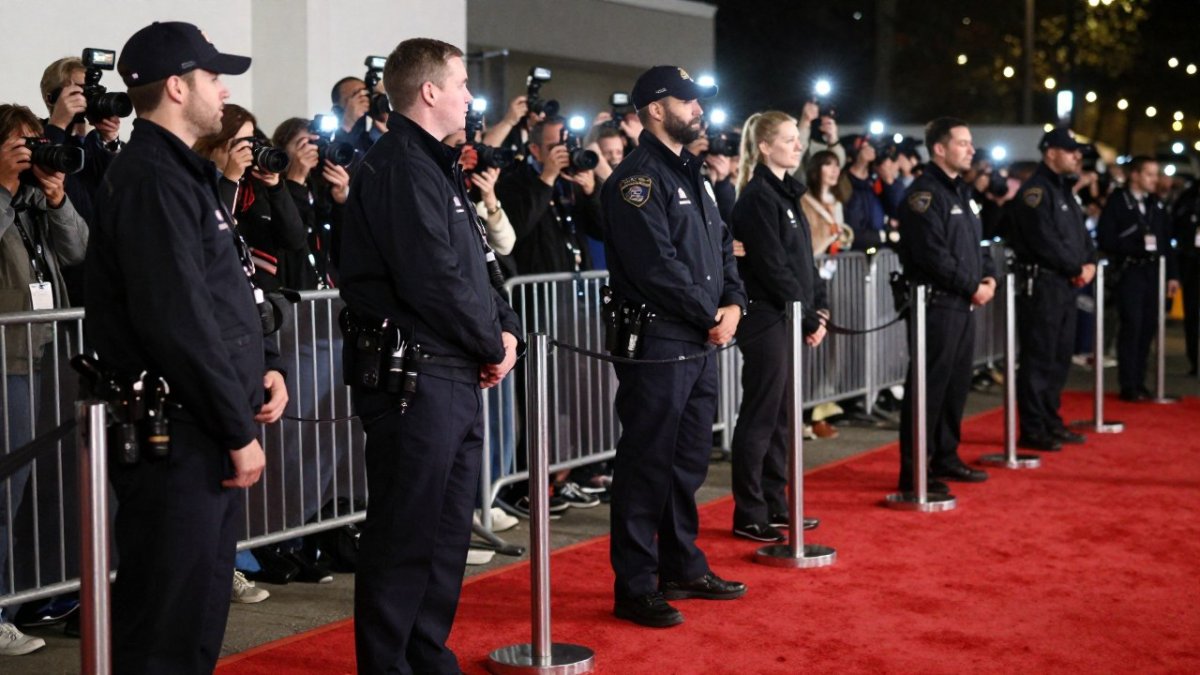
Red carpet crowd control comes down to barriers, spacing, and a carpet that never stops moving. Line the public edge with interlocking barriers and keep a clear buffer between the barrier and the carpet. That buffer is where a roving officer can step in without climbing over anyone.
Set the press pen at a fixed distance from the carpet with a defined shooting zone. Photographers stay behind the line; talent stops at marked positions. Predictable stopping points keep the press line calm and keep the carpet flowing.
For the guest-side queue, the same flow logic applies as any high-traffic photo experience. These tips on managing photo booth lines translate directly to keeping a red carpet queue moving without bottlenecks.
Managing the Press Line Without Stopping the Carpet
The press line fails when one outlet holds a celebrity too long. Fix it with a time budget: each stop gets a set number of seconds, and a press handler moves talent along on cue. Brief the handler before arrivals, not during them. If an outlet needs more, they book it in advance.
Coordinating Celebrity and VIP Arrivals and Departures
Arrivals and departures are the two moments when the perimeter is most exposed. Stagger arrival windows so two high-profile guests never reach the carpet at once. Confirm each vehicle's route and drop point in advance, and keep a separate, screened path for departures.
Departure is where plans often slip. Talent leaves tired, press is still working, and the crowd has shifted. Hold the same barrier line and the same officer posts until the last car clears. Do not release posts early to save on staffing hours.
The Event Incident Response Plan: From Breach to All-Clear
An event incident response plan is a one-page protocol that tells every officer what to do in the first sixty seconds of a problem. It covers who calls it in, who responds, who clears the area, and who gives the all-clear. Rehearse it at the briefing. A plan nobody has practiced is a plan nobody will follow.
Build the Plan Around Four Questions
Every scenario in the plan answers the same four questions, so officers can apply the logic to something the plan did not anticipate:
- Who calls it in? The officer who sees it, on the command channel, identifying their post first.
- Who responds? The command lead names the response, roving officers, the venue's duty manager, or emergency services.
- Who clears the area? A named supervisor, not whoever is closest.
- Who gives the all-clear? The command lead, and only the command lead.
The Most Common Incidents and How to Handle Them
- Unauthorized access at the front gate: hold the person at the checkpoint, radio the command lead, do not chase into the crowd.
- Crowd surge at the barrier: roving officers step to the barrier line, slow the carpet, and open a secondary exit.
- Press breach of the pen: press handler steps in first; officers only if the handler's request fails.
- Medical issue on the carpet: nearest officer calls it in and clears space; the carpet resumes once the person is moved.
Contingency Planning for the Scenarios That Rarely Happen
The incidents above are the everyday ones. The plan also needs a short playbook for the low-probability, high-impact events, because those are the ones where improvisation fails.
- Medical emergency beyond a minor issue: identify the nearest AED and first-aid station on the site map, name the officer who escorts emergency services in from the loading dock, and decide in advance whether the carpet pauses or reroutes. Do not let an ambulance route cross the press pen.
- Protest or demonstration at the public edge: hold the barrier line, do not engage, and let the command lead coordinate with the venue and local law enforcement. Keep the talent route screened and separate from the public edge.
- Severe weather: decide the covered holding area for talent and press before event day, and set a threshold for pausing arrivals. Wind is the usual problem with barrier runs and press tents, so confirm who authorizes a pause.
- Suspicious item or unattended bag: clear a radius, do not touch it, radio the command lead, and follow the venue's protocol and law enforcement direction. The carpet holds until the all-clear comes from the command lead.
- Evacuation: the venue's evacuation plan governs, not the security plan. Brief officers on the venue's exits and assembly point, and assign one officer per exit to keep the flow moving and prevent re-entry.
Watch out: a plan that only covers gate breaches and crowd surges leaves the team improvising on the scenarios that matter most. Write the contingency playbooks even if you never use them.
Rehearse It, Then Log It
Walk the plan at the briefing: read each scenario, confirm who owns the response, and run a radio check. During the event, the deputy command lead keeps an incident log with times, when it was called in, when the response arrived, when the all-clear was given. That log is the raw material for the post-event review, and it is the only reliable record of how the plan actually performed.
Accessibility and Guest Experience on the Red Carpet
Tight security and a good guest experience are not opposites. Reserve an accessible viewing area with a clear, barrier-free route to seating. Brief officers on assisting guests who use mobility devices, and keep one staffer assigned to that route.
A calm, well-signed carpet reads as professional to press and guests alike. The security perimeter should feel like part of the production, not an obstacle course.
The Premiere Day Runbook: A Chronological Checklist
A runbook is the hour-by-hour script for event day. Build it once and reuse it for every premiere.
- Confirm the venue's certificate of insurance and any security requirements are on file
- Brief all officers on post orders and the incident response plan
- Walk the full perimeter and confirm barrier placement
- Test radios and confirm every channel
- Staff the front gate with the live guest list
- Open the press pen and confirm the shooting zone
- Hold the pre-arrival huddle fifteen minutes before the first car
- Run arrival waves on schedule
- Hold all posts through the last departure
- Debrief before the team leaves the site
For venues with freight elevators and tight load-in windows, add those timings to the runbook too. Vendors and security both need to know who moves first.
Reviewing Security After the Premiere
The debrief is where a good security operation becomes a great one. Within 48 hours, gather the command lead, post officers, and the venue manager. Ask three questions: what worked, what nearly failed, and what changes next time.
Write the answers into the plan. A near-miss is free information. Log it, fix it, and the next premiere starts from a stronger position. Pair the review with a next-day event gallery so the team can see the guest-facing moments that the security plan protected. Here is why a next-day gallery matters for keeping momentum after the event.
Planning the Photo Moment Inside Your Security Perimeter
Every premiere has a photo moment, and it almost always sits inside the security perimeter. The carpet itself, the step-and-repeat, and any guest photo experience all need the same things security needs: a defined space, a controlled line, and someone in charge.
Plan the photo moment at the same time you plan the perimeter, not after. Decide where guests stop, how the line forms, and who manages it. A staffed photo experience with a trained attendant keeps guests moving and keeps your officers focused on security rather than queue management. That is how we run our corporate event photo booth setups: attendant on site all night, custom-branded print templates and overlays, and instant digital delivery to guests' phones alongside prints. Our Branded Photo Booth for Brand Activations follows the same staffed format.
For a broader look at premiere logistics, branding, and guest engagement, see our guide on how to enhance corporate events for film premieres.
The difference between a smooth premiere and a chaotic one is almost always the plan, not the guest list. If your event includes a photo moment inside the perimeter, Photobooth NYC can help you design it so it works with your security flow, not against it. Our staffed booths come with a trained attendant on site all night, custom-branded templates, instant prints, and digital delivery by text, email, or QR code. Booths range from $1,495 to $5,250 per booth depending on package, hours, and date, with every fee quoted upfront. Get started with Photobooth NYC and check availability for your date.
Frequently Asked Questions
What security measures are needed for a film premiere?
A film premiere needs layered measures: a written risk assessment, a credentialed guest list with check-in stations at every entry point, barriers separating the red carpet from the public, a screened press area, and a designated security team with a clear command structure. Add an incident response plan, coordinated VIP arrival and departure routes, and a staffed security post at each restricted area. The goal is authorized access only, with enough officers to manage crowd flow without blocking the guest experience.
How do you control crowds at a red carpet event?
Red carpet crowd control works best when you plan the flow before the first guest arrives. Use physical barriers to define the carpet lane, the press pen, and the public viewing area. Keep entry points separate from exits, stagger arrival windows by credential tier, and station officers at every barrier gap. A trained team that knows the layout can redirect a surge in seconds instead of minutes, which protects talent and keeps the arrival line moving.
What should organizers do if an unauthorized person enters the red carpet area?
Stay calm and follow the event incident response plan. The nearest officer should calmly intercept and escort the person to a secure spot away from talent and press, then verify credentials. If access was genuinely unauthorized, document the time, location, and entry point, then notify the security lead and venue management. After the event, review the breach in your post-event report and adjust staffing or barriers at that access point.
How should organizers manage guest access at a film premiere?
Use event access control procedures that match credential tiers to zones. Issue distinct credentials for talent, press, VIP guests, general guests, and staff, and check them at each entry point rather than only at the front gate. Keep a digital guest list synced with check-in stations, brief door staff on the verification steps, and log every credential check. Clear procedures at access points prevent unauthorized access and keep the red carpet moving.

