Benefits of Interactive Brand Activations
Table of Contents
- What Interactive Brand Activations Actually Do
- How Interactive Brand Activations Drive Audience Engagement
- Building Emotional Connections That Stick
- Interactive Brand Activation Ideas That Work
- Photo Booth Brand Activation for Corporate Events
- Brand Activation Lead Generation and Data Capture
- Measuring Brand Activation Success
- Making the Most of Your Activation Budget
- Bringing Your Activation to Life
- Frequently Asked Questions
Last Updated: October 20, 2026
What Interactive Brand Activations Actually Do
Interactive brand activations are experiences where consumers actively participate with a brand rather than passively observe it. Instead of watching an ad, guests engage directly, taking photos, playing games, entering contests, or creating shareable content. The difference matters: passive spectators forget. Active participants remember.
At Photobooth NYC, we've seen this play out across corporate events, product launches, and brand experiences. When attendees do something with your brand, not just see it, they form emotional connections that last. They talk about the experience afterward. They share photos on social media. They become advocates instead of audience members.
The core benefit is simple: engagement converts to awareness, and awareness converts to loyalty. A guest who spent five minutes interacting with your brand at an event is far more likely to recall it six months later than someone who glanced at a static display. That's not opinion, it's how human memory works.
How Interactive Brand Activations Drive Audience Engagement
Engagement happens when people feel invited to participate. The best activations remove barriers to entry and reward participation instantly.
A photo booth is one of the most effective engagement tools because it's intuitive. Guests don't need instructions. They walk in, smile, and get an instant keepsake. That immediate gratification, seeing themselves in a custom-branded frame moments after stepping out, creates a positive association with your brand. They're not just attending your event; they're creating a memory tied directly to your company.
The engagement multiplies when you add digital sharing. When guests text their photos to themselves or scan a QR code to download them, they're extending the experience beyond the physical event. They're sharing your brand with their networks. A single guest at your corporate gala becomes a distributor of your brand message to dozens of people who weren't even there.
Lead capture is another layer. For corporate events, brand activations, and product launches, photo booths equipped with email capture turn engagement into business intelligence. Guests provide their contact information to access their photos, and your team gains qualified leads. No hard sell. Just a natural exchange of value.
Building Emotional Connections That Stick
People don't remember facts. They remember how things made them feel.
An interactive brand activation creates a moment where attendees feel valued, worthy of the brand's attention and investment. When you set up a professional photo experience at your event, you're saying: "We care enough about you to create something special." That message registers emotionally, even if attendees don't consciously think about it.
The best activations also tap into social proof. When guests see other guests having fun, laughing in a photo booth, cheering at a game, they want to participate too. That peer influence is powerful. It transforms a brand touchpoint into a social experience, which makes it more memorable and more likely to be shared.
Customization amplifies this effect. When the photo booth backdrop features your company logo, brand colors, or event theme, every photo becomes a branded artifact. Guests aren't just taking pictures; they're taking pictures of your brand. Those images live in their phones and social media feeds long after the event ends, reinforcing your brand presence without additional effort.
Interactive Brand Activation Ideas That Work
Several formats consistently deliver results at corporate events and brand activations.
Photo booths remain the gold standard. They're fast, social, and produce instant keepsakes. Guests move through quickly, which means high participation rates even at large events. Custom overlays and branded templates turn casual photos into marketing assets.
Interactive games and contests work well when prizes are relevant and participation is easy. Spin-the-wheel games, trivia booths, or augmented reality experiences give guests a reason to stop at your activation longer than they would at a static display. The competitive element, even friendly competition, drives engagement.
Live product demonstrations work best when attendees can touch, test, or try something. Sampling, hands-on trials, or interactive product walkthroughs let people experience your offering firsthand. That direct experience is far more persuasive than any description.
Social media walls and hashtag campaigns encourage user-generated content. When guests post photos with your event hashtag, they're creating content and extending reach. The activation becomes a content engine, not just a one-time event.
Branded experiences tied to sensory elements, music, scent, texture, create stronger memory encoding. The more senses you engage, the more vivid the memory becomes.
Photo Booth Brand Activation for Corporate Events
A photo booth designed specifically for brand activation serves a different purpose than a photo booth for entertainment alone. It's a lead-generation tool, a social media engine, and a brand reinforcement device all at once.
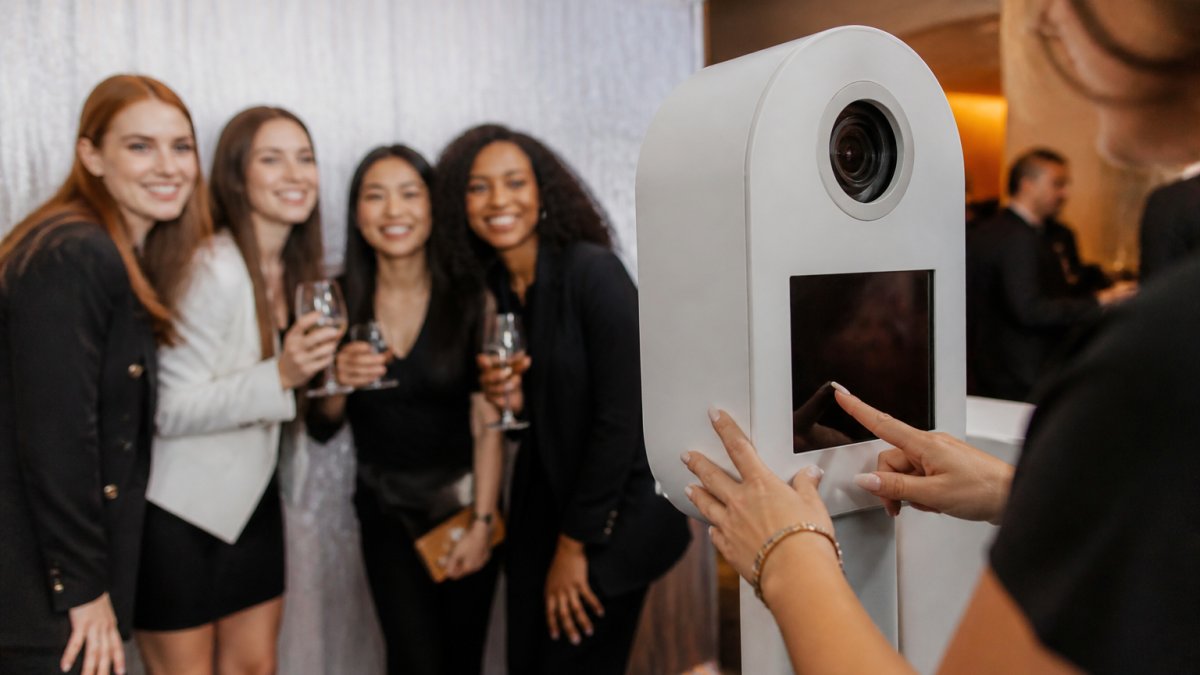
For corporate events, the booth should include custom-branded overlays, templates that match your brand guidelines, and professional printing. Guests walk away with a physical reminder of your brand. Digital sharing options, text, email, QR code, ensure the experience extends beyond the venue.
Lead capture is built in. Guests provide their email to access their photos, and your team gains contact information for follow-up. At a gala, a strong participation rate can generate qualified leads. That's measurable business value from a single activation.
The attendant matters. A trained professional keeps lines moving, ensures quality photos, and represents your brand in person. They can answer questions, manage technical issues, and create a polished experience that reflects well on your company. At Photobooth NYC, our team brings 20 years of live event production experience, which means booths are set up on schedule, managed professionally throughout the night, and struck quickly to meet venue load-out windows. For events across Manhattan, Brooklyn, Queens, Staten Island, and Long Island, a Branded Photo Booth for Brand Activations with a dedicated attendant ensures your activation runs smoothly from load-in to strike.
Brand Activation Lead Generation and Data Capture
Lead generation transforms a brand activation from an awareness tool into a sales tool.
When a photo booth requires email entry to access photos, you're not asking for something, you're offering value in exchange. The guest gets their photos. Your team gets their contact information. That's a fair trade, and it works because both parties get something tangible.
The data you capture is also valuable. You know which guests engaged with your brand, how long they spent at your activation, and what they looked like (useful for follow-up personalization). You can segment attendees by behavior, who participated, who didn't, who spent the most time at your booth, and tailor your follow-up messaging accordingly.
For multi-day corporate events or large conferences, a photo booth becomes a consistent touchpoint. Guests return multiple times across the event, deepening engagement. Each return is an opportunity to capture additional data or reinforce your brand message.
Measuring Brand Activation Success
Most activation write-ups stop at "track engagement." That's not a measurement plan. The useful move is to map each benefit you're chasing to a specific metric, a collection method, and a follow-up window, so you can tell after the event whether the activation actually did its job.
Here's a benefit-by-benefit framework you can adapt to your own goals.
Engagement → dwell time and participation rate. Participation rate is the share of event attendees who actually step into the activation. Dwell time is how long each participant stays. Both are observable on site: your attendant can log entries and rough time-in-zone, and a booth that captures a photo per session gives you a clean count. For a corporate event in the 200-400 guest range, a well-placed, well-signed booth is the kind of activation that tends to draw steady traffic rather than a single early rush, watch the hourly count to see whether you're reaching late arrivals or only the first wave.
Awareness → recall lift. Recall can't be measured at the event; it has to be measured after. A short post-event survey sent within two weeks, asking attendees to name brands they remember from the event unprompted, gives you a recall signal. Compare against a control group of invitees who didn't attend, if you have one. The gap between the two is your recall lift.
Message takeaway → prompted recall of the specific claim. Unprompted recall tells you the brand stuck; prompted recall tells you whether the message stuck. Ask attendees to match your brand to the one-line claim you were pushing at the activation. If they can't, the creative was memorable but the message wasn't.
Conversion → qualified leads and follow-up response rate. Count leads captured, then count how many respond to your first follow-up. The response rate is the honest conversion signal, a big list that ignores your email is not a win. Segment by engagement depth (participated vs. didn't, returned vs. single visit) and compare response rates across segments.
Advocacy → share rate and user-generated content volume. Track how many participants shared their photo or post, and how many posts carried your event hashtag. Share rate per participant is more useful than raw share count because it normalizes for event size.
Reach extension → secondary impressions. Every share reaches people who weren't in the room. Estimate secondary reach from platform analytics on tagged posts and from QR-code or link scans on digital photo delivery. This is the number that justifies the activation to stakeholders who only care about reach.
Attribution is the hard part, plan for it. Attendance and social reach are not outcomes; they're inputs. To connect an activation to later sales or retention, tag the leads you capture with a source label in your CRM, then compare close rates and repeat-purchase rates against leads from other channels over the following two quarters. If you can't tag at capture, you can't attribute later.
What to write down on the day. Have the attendant or on-site lead log: total participants, hourly counts, peak window, number of returns, and any technical issues. Those five data points, combined with your post-event survey and CRM tags, give you a defensible read on whether the activation earned its place in next year's budget.
A measurement plan doesn't need to be elaborate. It needs to be decided before load-in, collected on site, and followed up within the window when the event is still fresh.
Making the Most of Your Activation Budget
Budget conversations about activations usually go one of two ways: either the number is treated as a black box, or it's treated as the only variable that matters. Neither helps you plan. The practical approach is to understand what drives cost, what drives results, and where the trade-offs actually sit.
Start with the objective, then let it set the format. Lead capture, awareness, and product trial pull toward different activation types and different staffing levels. A photo booth with branded overlays and email capture is a strong fit when your goal is leads plus shareable content; a hands-on sampling station is a stronger fit when the goal is trial. Choosing the format before the objective is how budgets get spent on the wrong thing.
Staffing is a line item, not an afterthought. A fully attended activation needs a trained attendant for the full run of the event, not a shared body who checks in every 20 minutes. Attendants keep lines moving, protect photo quality, troubleshoot on the spot, and represent your brand in person. If your event runs long or has a peak window, plan coverage around that window rather than spreading one attendant thin across the whole night. Understaffing shows up as longer lines, dropped sessions, and a worse guest experience, which is the opposite of what the activation is for.
Logistics drive cost more than most planners expect. In this market, venue requirements are the hidden budget line. Certificates of insurance, freight elevator reservations, loading dock windows, and tight load-in and strike times all affect how a vendor prices and schedules your activation. A venue with a narrow strike window may require a larger crew or a faster teardown plan. A venue without a freight elevator changes what can be brought in and how long setup takes. Ask your venue for its COI requirements, load-in window, and strike deadline before you finalize the activation plan, those three answers shape the quote more than the guest count does.
Accessibility is a budget and design decision. An activation that only works for guests who can stand in a line, reach a certain height, or use a touchscreen excludes part of your audience and shrinks your participation rate. Plan for a clear approach path, seating nearby for guests who need it, and instructions that work for guests with hearing or vision limitations. Accessible participation isn't a nice-to-have; it's how you protect the reach you paid for.
Privacy and consent belong in the plan. If you're capturing emails or photos, tell guests what you're collecting and why, and give them a clear way to opt out of marketing follow-up. A short consent line at the capture point protects your brand and keeps your list clean. Responsible data collection is also better data, people who understand the exchange are more likely to engage with your follow-up.
Plan the follow-up before you spend the first dollar. The most common budget mistake is treating the event as the finish line. Decide in advance who owns follow-up, what the message says, and when it goes out. A follow-up within the first 48 hours, referencing the specific activation, tends to outperform a generic message sent weeks later. If you can't resource the follow-up, you're paying for leads you won't convert.
Know the failure modes and price them in. Low participation usually traces to poor placement or weak signage, fix it by securing high-traffic real estate and making the activation visible from the main flow. Technology hiccups are best handled by a trained attendant who can troubleshoot without stopping the line. Poor audience fit is a planning error: match the format to who's actually in the room. Weak follow-up is the most expensive failure because it wastes every other investment.
Get the full number upfront. Ask for a written quote that itemizes hours, staffing, delivery, and any venue-related fees, and confirm what's included versus what's billed separately. A quote you can compare line by line is the only way to know whether you're buying the activation you think you are.
Budgeting an activation well is less about finding the cheapest option and more about matching spend to objective, staffing the experience properly, and planning the follow-up that turns a one-night interaction into a measurable result.
Bringing Your Activation to Life
Planning an interactive brand activation starts with clarity on what you want to achieve and who you're trying to reach.
Define your goal: leads, awareness, loyalty, or a combination. Identify your target audience within the event. Choose an activation format that fits your goal and your venue. For corporate events, a professional photo booth with lead capture, custom branding, and instant digital delivery works well because it checks multiple boxes, it's engaging, it captures data, and it creates shareable content.
Work with a vendor who understands event logistics. NYC and Long Island venues have strict requirements: insurance, certificates of insurance, load-in windows, freight elevator access, and tight strike times. A vendor with experience navigating these constraints will deliver and execute smoothly, not scramble at the last minute.
Communicate your brand guidelines clearly. Custom overlays, print templates, and digital templates should all reflect your brand aesthetic. Consistency across all touchpoints reinforces brand recognition.
Plan for follow-up before the event. Decide what you'll do with the leads or data you capture. Draft your follow-up messaging. Set a timeline for outreach. The activation is the beginning of a conversation, not the end of one.
If you're planning a corporate event, brand activation, or gala in Manhattan, Brooklyn, Queens, Staten Island, or Long Island, check availability for a Corporate Event Photo Booth Rental that fits your timeline and goals.
Frequently Asked Questions
What is an interactive brand activation?
An interactive brand activation is a live, in-person experience designed to engage your audience with your brand in a memorable way. Unlike passive advertising, interactive activations invite participation, whether through a photo booth, product sampling, game, or hands-on experience. The goal is to create a direct connection between your brand and consumers, generate awareness, and often capture data or leads for follow-up.
How do interactive brand activations increase audience engagement?
Interactive activations work because they require participation, not just observation. When guests physically engage with your brand, taking photos, sharing content, or trying a product, they spend more time with your message and create personal memories tied to your brand. This active involvement increases dwell time, encourages social media sharing, and generates user-generated content that extends your reach beyond the event itself.
How can a photo booth support a brand activation?
A branded photo booth is a powerful activation tool because it combines entertainment with brand exposure. Guests interact with custom-branded overlays, backdrops, and print templates that reinforce your message. They share photos digitally and take prints home, creating multiple touchpoints with your brand. For corporate events, a photo booth also captures attendee data through digital delivery, generating qualified leads and first-party data for marketing follow-up.
How should brands measure the success of an activation?
Track metrics that align with your campaign objectives. Count participation rate (how many guests engaged), reach (social shares and impressions), dwell time (how long people spent at your activation), and conversion (leads captured, email signups, or sales). For brand awareness, measure recall through post-event surveys. For corporate events, monitor lead quality and follow-up conversion. Digital analytics, shares, QR code scans, email opens, provide concrete ROI data.
Interactive brand activations work because they create moments where your brand becomes part of people's memories. When done well, they generate leads, extend reach, and build loyalty. If you're planning a corporate event, product launch, or brand experience in Manhattan, Brooklyn, Queens, Staten Island, or Long Island, check availability with Photobooth NYC to see how a professionally managed photo booth activation can serve your goals.
