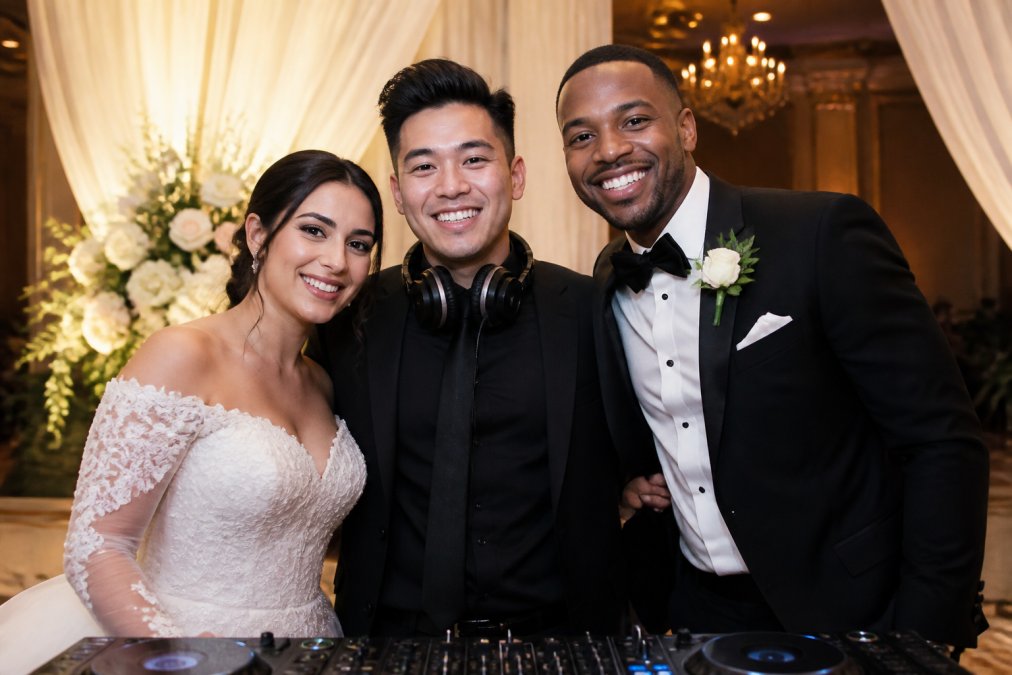
Wedding DJ Cost in NYC: Pricing Guide & What to Expect
Table of Contents
Last Updated: September 20, 2026
Wedding DJ Cost in NYC: Price Ranges by Tier
Understanding wedding DJ cost NYC requires knowing that pricing varies dramatically based on experience level, equipment quality, and service scope. The market typically breaks into three distinct tiers: budget-friendly options for smaller celebrations, professional mid-range services for standard receptions, and luxury entertainment packages that include advanced production elements.
Budget DJs generally handle basic music and mixing for 4-6 hours. Professional wedding DJs bring refined equipment, MC services, and crowd engagement expertise. Luxury tier providers add lighting design, video integration, and specialized audio systems tailored to venue acoustics. Each tier reflects not just hourly rates but the quality of equipment, experience managing large crowds, and ability to read a room and adjust the energy throughout the night.
The difference between tiers isn't arbitrary. A budget DJ might rely on a standard sound system and pre-built playlists. A professional wedding DJ invests in redundant equipment, wireless microphones, and real-time mixing to adapt to your specific venue. A luxury provider includes custom lighting rigs, video screens, and often coordinates with other vendors to create a fully integrated production experience.
Factors That Affect Wedding DJ Pricing
Several variables drive the cost of a wedding DJ beyond the basic tier selection. Understanding these factors helps you anticipate where your budget should go and what represents genuine value versus unnecessary premium charges.
Venue size and acoustic conditions dramatically impact pricing. A small, acoustically dead ballroom requires different equipment than a loft with hard surfaces that create feedback. DJs experienced with NYC venues understand these challenges and price accordingly. A venue with poor acoustics might require additional sound treatment or higher-end equipment, which increases the DJ's costs and your final bill.
Event duration extends beyond the reception itself. Many couples book DJs for ceremony sound, cocktail hour background music, and the full reception. Each additional hour carries a cost. Peak season pricing applies during May through October, when demand is highest. Off-season events (November through April, excluding December holidays) often see 15-25% discounts as DJs have more availability.
Travel fees within the five boroughs and surrounding areas vary by provider. Some DJs include local travel in their base rate; others charge separately. Setup complexity matters too. A straightforward reception in a venue with existing sound infrastructure costs less than installing a complete system in a raw space. Equipment specifications you request, whether you want wireless microphones, uplighting, or video projection, directly affect the final price.
What Is Included in Wedding DJ Services
A standard wedding DJ package typically includes music selection and mixing, MC duties, ceremony sound coordination, and basic lighting. Understanding what's bundled versus what costs extra prevents surprise charges on invoice day.
Most professional wedding DJs provide their own turntables or controllers, mixer, and primary speakers. They handle all music curation, taking requests from guests while maintaining the energy arc of your reception. The MC role, announcements, toasts, first dance introductions, and crowd engagement, is core to the service. This is where experienced DJs earn their value. A skilled MC reads the room, knows when to speed up the music or slow things down, and keeps energy high without being obnoxious.
Wireless microphones for speeches and announcements are standard in professional packages. Ceremony sound, amplifying your officiant and vows, is often included. Many DJs provide basic uplighting or pin spots to highlight the dance floor or sweetheart table. An online gallery or digital backup of the night's music selections sometimes comes with the package.
What's typically NOT included: custom lighting design beyond basic uplighting, video screens or projection, additional hours beyond the contracted time, premium sound reinforcement for large outdoor spaces, or coordination with live musicians. These are add-ons that increase the final cost but can transform the reception experience.
Wedding Reception Music Timeline: Planning Your DJ Coverage
The way a wedding DJ structures the night directly impacts guest experience and your overall satisfaction. Understanding the typical timeline helps you allocate your DJ budget effectively and plan what coverage you actually need.
Ceremony sound setup usually takes 1-2 hours before guests arrive. The DJ tests microphones, confirms music levels, and coordinates with your officiant. Cocktail hour (typically 1-1.5 hours post-ceremony) requires ambient background music, lower energy, conversational volume. This is where a curated playlist or a skilled DJ reading the room makes a difference.
Dinner typically lasts 1-1.5 hours with moderate background music. Toasts and special moments (cake cutting, first dances, parent dances) happen during or immediately after dinner. This is where MC duties become critical. A good DJ announces these moments, manages timing, and keeps energy building toward the open dancing.
Open dancing usually runs 3-4 hours. This is where the DJ's ability to read the crowd becomes essential. Early in the dancing, songs might be more structured and recognizable. As the night progresses and alcohol flows, a skilled DJ shifts to higher-energy tracks, builds momentum through peak hours, and winds down gracefully toward the end of the night.
Total DJ coverage typically runs 6-8 hours from setup through final song. Some couples add ceremony-only or cocktail-hour-only packages if they're hiring a separate band or want to minimize costs. Others extend coverage for late-night dancing or after-parties.
Additional Costs and Add-Ons to Budget For
Beyond the base DJ package, several add-ons and hidden costs can increase your final bill. Understanding these upfront prevents budget surprises and last-minute complications.
Liability Insurance and Certificate of Insurance (COI)
Most NYC venues require proof of liability insurance from all vendors, including DJs. This is typically documented via a Certificate of Insurance (COI), a formal document showing the DJ carries general liability coverage (usually $1 million minimum). This is not optional, venues will not allow an uninsured DJ to perform, and you cannot substitute your own insurance.
Some established DJs already carry liability insurance and can provide a COI at no additional cost. Others do not carry insurance and will either decline to work your venue or ask you to add them to your event insurance policy, which typically costs $200-500 for a one-day rider. A few DJs pass this cost to you directly.
To avoid last-minute stress, confirm insurance status early in the booking process. Ask the DJ: "Do you carry liability insurance? Can you provide a Certificate of Insurance naming my venue as an additional insured?" Get a copy of the COI before signing the contract. If the DJ does not carry insurance, contact your event insurance provider immediately to understand the cost and timeline for adding them. Waiting until two weeks before the wedding to address this can result in rushed paperwork, higher costs, or the DJ being unable to perform.
Overtime Rates
Overtime applies when you extend beyond your contracted hours. Most DJs charge hourly rates for additional time, typically 25-50% higher than the base hourly rate. If your base rate is $150/hour and you extend 30 minutes, expect to pay $225-300 for that half hour. A full additional hour might cost $225-400 depending on the tier. Plan your timeline carefully to avoid surprise overtime charges. If you think you might want extended coverage, negotiate the overtime rate upfront as part of the contract.
Equipment Upgrades
Premium sound systems for large outdoor spaces or venues with poor acoustics add $300-1000+. Wireless microphones beyond the standard one or two add $100-200 per additional mic. Video projection (for slideshows, lyrics, or ambient visuals) costs $500-1500 depending on screen size and content complexity. Custom uplighting or laser effects add $200-800. Each upgrade is negotiable, so prioritize what matters most to your vision and budget accordingly.
Travel Fees
Travel fees for venues outside the immediate service area vary significantly. Some DJs include mileage within a 5-mile radius of their home base; others charge separately. Venues in Long Island, Westchester, or New Jersey can incur travel fees of $100-500 one-way. If your venue is more than 30 minutes from the DJ's location, confirm travel costs upfront. Some DJs charge a flat fee; others charge per mile. Get this in writing to avoid disputes.
Music Licensing Fees
Music licensing fees are rarely charged to couples directly (DJs typically cover this as part of their business expense), but it's worth confirming. In rare cases, a DJ might pass licensing costs to you if you request extensive custom playlist curation or if your venue requires special licensing for public performance. This is uncommon but worth asking about.
Custom Playlist Curation
If you want the DJ to build a detailed, pre-planned playlist before the event (beyond standard request management), some DJs charge an additional fee of $200-500. This is useful if you have very specific musical preferences or want to avoid certain genres entirely. Standard DJ packages typically include request management on the day of the event, so pre-planning is optional.
Backup DJ or Substitute Coverage
Some DJs charge a fee ($100-300) if you want a guaranteed backup DJ in case of illness or emergency. Others include this as part of their service. Clarify this in the contract. A professional DJ should have a backup plan; if they don't, that's a red flag.
Setup and Breakdown Time
Most DJ packages include setup and breakdown, but confirm the timeline. If your venue has strict load-in windows or limited setup time, some DJs may charge extra for expedited setup or for setup outside standard hours. A DJ arriving at 2 PM for a 6 PM ceremony is standard; a DJ arriving at 4 PM for a 6 PM ceremony might incur a rush fee.
Creating a Complete Budget
To avoid surprises, request an itemized quote that includes:
Base DJ fee (hours and scope)
Equipment included (speakers, microphones, lighting)
Travel fees (if applicable)
Overtime rates (per hour or per 30 minutes)
Any add-ons you're considering (uplighting, video, wireless mics)
Insurance/COI status (included or additional cost)
Cancellation and refund policy
Payment schedule (deposit, balance due date)
A professional DJ will provide this breakdown without hesitation. If a DJ is vague about costs or refuses to itemize, find someone else.
Questions to Ask a Wedding DJ Before Booking
Asking the right questions separates experienced professionals from DJs who will disappoint you. These are the non-negotiable items to clarify before signing a contract.
Ask whether the DJ will personally attend your event or send a substitute. Experienced professionals show up themselves; less established DJs sometimes hire replacements. Verify this in writing.
Ask about backup equipment. What happens if the main sound system fails? A professional wedding DJ carries redundant equipment, backup mixer, speakers, and power supplies. This is non-negotiable for a $2000+ event.
Ask how the DJ handles requests and special songs. Do they take requests from guests all night, or only before the event? Can you provide a "do not play" list? A good DJ balances your vision with crowd energy.
Ask about their experience with your specific venue. Have they worked there before? Do they understand the acoustics and load-in procedures? This matters more than you'd think.
Ask whether they provide wireless microphones and how many. If you have 8 people giving toasts, you need reliable wireless mics, not a single handheld.
Ask about their MC experience and style. Will they be high-energy and comedic, or more subtle and professional? This shapes the entire reception tone.
Ask what happens if they get sick or an emergency arises. Is there a backup DJ guaranteed, or do you get a refund? This protects you.
Ask for references from recent weddings. Call 2-3 couples and ask about reliability, equipment quality, and crowd engagement.
DJ vs. Live Band: Entertainment Value and Cost Comparison
Many couples debate whether to hire a DJ or a live band. Each offers distinct advantages and carries different cost implications.
A DJ provides continuous music, unlimited song selection, and the ability to read the room and adjust instantly. DJs cost less than bands and fit in smaller spaces. The trade-off: no live energy or acoustic instruments.
A live band delivers authentic musicianship, a unique atmosphere, and genuine entertainment value during the ceremony and cocktail hour. Bands typically cost 30-50% more than DJs and require more space for instruments and musicians. Bands excel at creating an upscale, sophisticated vibe but have limited song selection and less flexibility to respond to crowd energy.
Many couples hire both: a live band for cocktail hour and early dinner, then a DJ for dancing. This hybrid approach combines the elegance of live music with the flexibility and cost-efficiency of DJ-driven dancing. The total cost is higher than either alone but often delivers the best guest experience.
For most wedding budgets, a professional DJ represents better value than a band. You get continuous entertainment, broader song selection, and a skilled MC who manages the entire reception flow. If budget is tight, a DJ is the smarter choice.
Venue-Specific Acoustic Challenges and Equipment Needs
NYC venues present acoustic environments that directly impact DJ equipment requirements and final costs. Understanding these challenges helps you anticipate equipment needs, ask informed questions during DJ consultations, and avoid surprise charges on invoice day.
Loft and Industrial Spaces
Exposed brick, concrete floors, and hard surfaces create sound reflections and standing waves that cause feedback and muddy audio. A DJ working a loft must invest in better equipment placement, acoustic treatment, or upgraded speakers to compensate. Specifically, this often means bringing a second subwoofer for bass management ($300-600 additional cost), using directional speakers to prevent wall reflections, or deploying acoustic panels. A DJ unfamiliar with loft acoustics may underestimate these needs and deliver poor sound quality. When interviewing DJs, ask if they've worked your specific loft before and what equipment adjustments they anticipate. Budget an extra $300-800 for loft venues compared to ballroom equivalents.
Ballrooms and Historic Venues
High ceilings (15+ feet) and carpeted floors generally offer good acoustics, but many older ballrooms have outdated in-house sound systems that are unreliable or incompatible with modern DJ equipment. A professional wedding DJ will either integrate with the existing system (requiring testing and potential audio interface equipment, $100-300) or bring a complete standalone system. Historic venues often have strict load-in windows and limited electrical outlets, forcing DJs to plan carefully and sometimes use battery-backed equipment or hire additional crew for setup. Ask your venue what sound infrastructure exists and whether the DJ can use it or must bring their own. This affects both cost and setup complexity.
Outdoor and Rooftop Venues
Outdoor spaces introduce weather exposure, ambient noise (traffic, wind), and lack of natural sound containment. A DJ covering a rooftop or garden requires weather-sealed equipment cases, more powerful speakers to overcome ambient noise, and often a backup power source in case of electrical issues. Outdoor setups typically cost 25-40% more than comparable indoor events because equipment is more robust and speaker output must be higher. Wind can also affect wireless microphone signals, so some DJs use hardwired mics for outdoor ceremonies. If you're considering an outdoor venue, budget accordingly and confirm the DJ has outdoor experience.
Basement and Enclosed Spaces
Basements with low ceilings or poor ventilation create heat buildup that can damage DJ equipment (mixers, amplifiers, turntables). A DJ working a basement may need to bring cooling fans, position equipment away from heat sources, or take frequent breaks to prevent equipment failure. Some DJs charge an additional $200-400 "challenging venue" fee for basements. Additionally, basements often have poor cell signal, which affects wireless microphone performance and the DJ's ability to receive real-time requests or emergency communications.
Asking the Right Acoustic Questions
When consulting with potential DJs, ask these specific questions:
"Have you worked this venue before? What acoustic challenges did you encounter?"
"Will you use the venue's existing sound system or bring your own? Why?"
"What equipment adjustments do you anticipate for this space, and what will that cost?"
"Do you have backup equipment if something fails due to venue conditions?"
"What is your setup timeline, and does the venue's load-in window accommodate it?"
A DJ who can articulate specific acoustic concerns and equipment solutions demonstrates expertise. A DJ who says "it'll be fine" without assessing the space is a red flag. The cost difference between a DJ who understands your venue's acoustics and one who doesn't can be $500-1500 in unexpected equipment fees or poor sound quality on the day.
How to Choose the Right Wedding DJ for Your Budget
Selecting a DJ is as much about personality fit and reliability as it is about price. A cheap DJ who disappoints costs more in regret than a professional who delivers.

Start by defining your budget and what tier of service that supports. Be realistic. A $1,200 budget signals a different level of service than a $3,500 budget. Once you know your range, research DJs who operate in that tier.
Listen to samples of their work. Most professional DJs provide audio clips or video reels. Pay attention not just to song selection but to how they mix and transition. Do they read the room? Do transitions feel smooth or jarring?
Check references. Call at least two couples who hired this DJ in the past 12 months. Ask about reliability, equipment quality, MC skills, and whether they'd hire them again. This is worth the 20 minutes it takes.
Interview multiple DJs before deciding. Ask the questions outlined earlier. Notice how they respond. Do they answer thoroughly or brush off concerns? A professional takes your questions seriously.
Review the contract carefully. Ensure it specifies the exact date, time, duration, equipment included, overtime rates, cancellation policy, and what happens if the DJ can't perform. Get everything in writing.
Check their liability insurance status. Many venues require proof of insurance. Confirm this early so it doesn't delay your booking.
Trust your gut. The right DJ feels like someone you can work with, someone who understands your vision and has the experience to execute it. Price matters, but reliability and professionalism matter more.
Choosing the right entertainment for your wedding shapes the entire guest experience.
Frequently Asked Questions
How much is a DJ for 4 hours at a wedding?
A 4-hour wedding DJ package cost depends on the DJ's tier and experience level. Budget DJs typically charge less, while professional and luxury entertainment providers command higher rates. Peak season (May-October) costs more than off-peak dates. Travel fees, equipment upgrades, and additional services like lighting or an MC also affect the final price. Contact a local DJ directly for a quote based on your specific date and requirements.
What factors influence the total cost of wedding entertainment?
Several factors shape wedding DJ pricing: season (peak vs. off-peak), day of the week, event duration, travel distance within the region, DJ experience and reputation, equipment quality, sound system requirements for your venue, overtime rates, add-ons like wireless microphones or event lighting, and liability insurance. Venue acoustics and size also matter, larger or acoustically challenging spaces may require upgraded sound equipment, raising costs.
Does the cost of a wedding DJ include equipment and lighting?
Standard wedding DJ packages typically include a sound system, wireless microphone, and basic setup. However, premium packages or add-ons may include dance floor lighting, uplighting, audio-visual equipment, or professional-grade sound systems for large venues. Always ask your DJ what's included in their base package and what costs extra. Equipment needs depend on your venue size and your vision for the reception atmosphere.
How far in advance should you book a wedding DJ?
Book a wedding DJ 6-12 months ahead, especially if your wedding falls during peak season (May-October) or on a Saturday. Popular DJs and experienced professionals book quickly during these periods. Off-peak dates (November-April) and weekday events offer more availability and sometimes lower rates. Early booking also gives you time to discuss your music preferences, review contracts, and plan your reception music timeline with your DJ.
