Branded Event Activation Ideas for Conferences
Table of Contents
What Makes a Branded Event Activation Successful at Conferences
Conference Brand Activation Ideas That Drive Real Engagement
Interactive Conference Booth Ideas That Stop Attendees in Their Tracks
Photo Booth Brand Activation: Turning Moments Into Marketing Assets
Planning Your Conference Activation: Venue, Schedule, and Attendee Journey
Last Updated: October 15, 2026
What Makes a Branded Event Activation Successful at Conferences
A successful branded event activation captures attention, creates shareable moments, and drives measurable business results. The best conference activations stop foot traffic, make participation frictionless, and deliver something attendees want to keep or share.
The strongest activations also solve a problem: attendees are tired after a day of sessions, and your activation gives them permission to step away, have fun, and get something out of the experience.
Conference Brand Activation Ideas That Drive Real Engagement
The best conference brand activation ideas fall into two categories: speed and volume, or depth and customization. The strongest programs mix both.
Interactive Photo Experiences and Instant Keepsakes
Photo moments are the engine of modern conference activations. Attendees expect to capture and share, so make it easy and on-brand and participation jumps.
The setup is simple: a clean backdrop, professional lighting, and a camera or tablet.
Custom props tied to your brand message make photos more shareable, oversized product mockups for a tech company, branded signs with clever messaging for a consulting firm.
Professional-grade systems deliver editorial-quality images with custom color grading to match your brand palette. The Branded Photo Booth for Brand Activations option includes full customization of backdrops, print templates, and color grading to ensure every image reinforces your brand.
Live Polling and Real-Time Feedback Walls
Interactive walls showing live polling results create a sense of participation: attendees vote via phone or a physical interface, and results appear instantly on a large screen. Keep questions quick and relevant. This works especially well for product launches or industry research, attendees feel heard, your brand captures real-time data, and changing results keep people watching.
Branded Scavenger Hunts and Check-In Challenges
Scavenger hunts extend engagement across multiple booths and sessions. Attendees collect stamps, scan QR codes, or complete challenges to earn prizes, keeping them moving and talking about your brand.
Check-in challenges work the same way: attendees check in at your booth by phone or printed card, and each check-in enters a drawing or unlocks a reward, capturing contact information and creating repeat engagement.
Augmented Reality and Digital Passport Experiences
AR experiences create novelty and shareability: attendees point their phones at your booth or a branded object and see a digital layer appear, immersive and inherently social.
Both formats require technical setup and testing, but the payoff is high engagement and viral potential: attendees share AR experiences on social media, and digital passports create a follow-up touchpoint.
Silent Disco and Themed Pop-Up Spaces
A silent disco is a dance or social experience where attendees wear wireless headphones tuned to your branded playlist or message, immersive, shared, and non-disruptive.
Themed pop-up spaces work differently: a small, immersive environment (a lounge, VR corner, or photo studio) that feels separate from the main floor.
Both formats work best when they're optional and feel like a reward for visiting your booth. Let attendees self-select into the experience.
Interactive Conference Booth Ideas That Stop Attendees in Their Tracks
Your booth competes for attention in a crowded environment. The best booths do one thing exceptionally well rather than trying to do everything.
Custom-Branded Backdrops and Themed Props
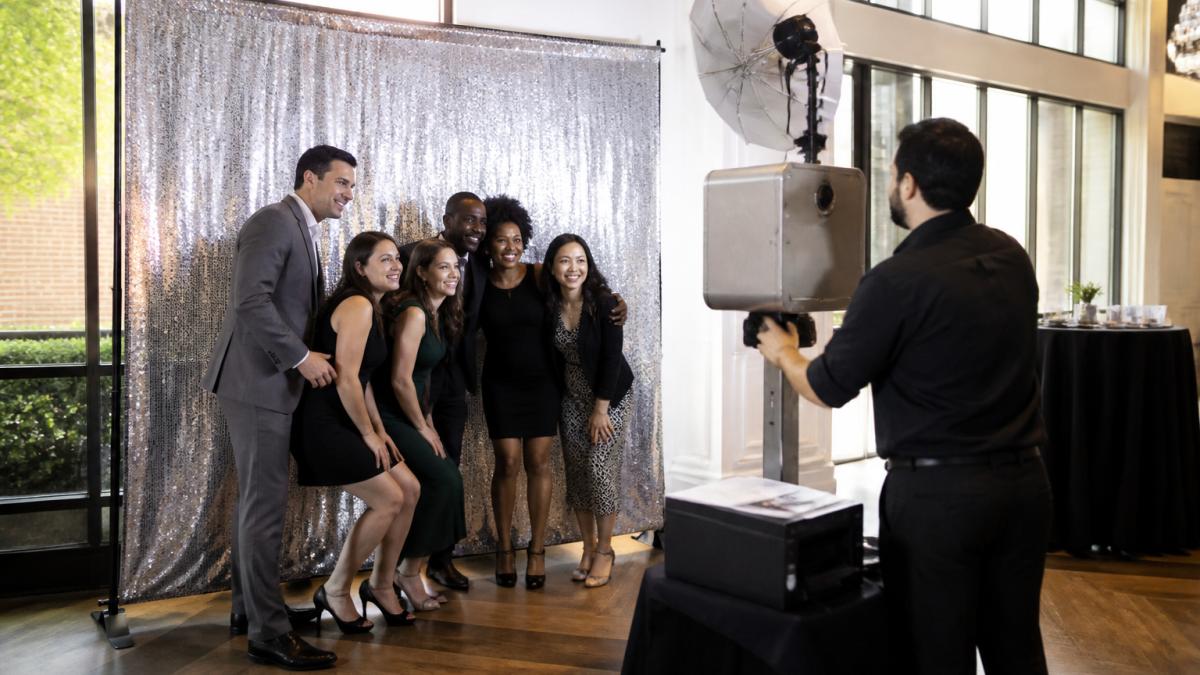
The backdrop is your first visual asset: clean, on-brand, and Instagram-ready. Avoid clutter, a bold color palette with your logo and a clear call to action works best.
Props should enhance photos without overwhelming them. A few well-chosen items beat a pile of random objects, oversized product mockups, branded signs, or industry-relevant props all work.
Lighting matters more than most teams expect: professional studio lighting makes the difference between a candid photo and a polished asset. The Premium Photo Booth Package includes pro camera and studio lighting setups, while tablet-based systems rely on ambient light, which works in well-lit spaces.
Gamification: Challenges, Prizes, and Leaderboards
Gamification drives repeat visits: attendees come back to beat their score or climb the leaderboard. A simple scoring system, most creative pose, best group photo, fastest participation, creates friendly competition.
Prizes should be meaningful but achievable.
Leaderboards work best when visible in real time. A digital display of top performers creates momentum, and attendees want to see their name or group on the board.
Social Sharing Stations and QR Code Integration
Make sharing effortless. A QR code printed on every photo lets attendees share instantly to their phone.
Social sharing stations work even better: a tablet or screen at your booth lets attendees tag themselves and share directly to their social accounts.
Every share is a multiplier: one attendee's post reaches their network, giving your activation visibility you didn't pay for.
Photo Booth Brand Activation: Turning Moments Into Marketing Assets
A photo booth is more than entertainment. It's a content generation machine. Every photo is a potential marketing asset if you set it up right.
The key is customization. A generic photo booth with a plain backdrop doesn't reinforce your brand.
Instant prints are critical. Attendees leave with a physical reminder of your brand. Digital sharing extends reach.
The Signature Photo Booth Package includes dual-printer capability with 2x8 or 6x8 print options, custom-branded templates with your logo and event name, and glam filters and color grading to ensure every image matches your brand aesthetic.
Conference Engagement Ideas by Budget and Complexity
Not every activation needs a massive budget. The most effective activations are often simple, well-executed ideas. Here's how to think about budget and complexity.
Entry-Level Activations: Quick Setup, High Impact
A basic photo setup with a branded backdrop and props requires minimal technical investment: 30 minutes of setup, one staffer, low cost, real engagement. The Standard Photo Booth Package offers an affordable entry point for conferences with straightforward photo capture and printing.
A branded scavenger hunt with printed cards and small prizes works the same way, low cost, high participation, easy to execute. A live polling station with a tablet and a few questions captures data without complex tech.
These activations work best when focused. Do one thing well rather than trying to be everything.
Mid-Tier Activations: Immersive Experiences and Custom Environments
A custom-built booth with professional lighting, a tablet-based photo system, and themed props creates a more immersive experience.
A silent disco or themed lounge requires audio equipment and space, but the novelty drives traffic and creates memorable moments.
An AR experience or digital passport system adds technical complexity but creates shareable content and captures data.
These activations justify a larger budget because they drive higher engagement and generate more qualified leads.
Premium Activations: Multi-Day Campaigns and Hybrid Digital Experiences
A professional-grade photo booth with studio lighting, a professional camera, dual printers, and full custom branding is a premium activation. The Premium Photo Booth Package and Signature Photo Booth Package both deliver this level of quality for high-impact conference activations.
A multi-day activation spanning the entire conference with changing themes, rotating experiences, or escalating challenges keeps engagement high throughout the event.
These premium activations justify significant investment because they generate content, leads, and brand visibility that last long after the event ends.
Measuring Your Conference Activation: KPIs That Matter
Most roundups stop at "track engagement." That advice is useless the week after the event, when someone in finance asks what the activation actually produced. Define your metrics before you build the booth, assign each one an owner, and decide in advance what a good result looks like.
Pick one primary KPI and two supporting KPIs
A common mistake is tracking ten metrics and optimizing for none. Choose one primary KPI tied to your business goal, plus two supporting metrics that explain why the primary moved.
Business goal | Primary KPI | Supporting KPIs |
|---|---|---|
Pipeline generation | Qualified leads captured | Lead-to-meeting rate, cost per qualified lead |
Brand awareness | Unique participants | Social reach, branded hashtag volume |
Content production | Usable branded assets created | Asset download rate, post-event asset reuse |
Product feedback | Completed survey responses | Dwell time, response completion rate |
If your goal is pipeline, don't celebrate a high participation number that produced no qualified contacts. If your goal is awareness, don't over-index on lead count from a booth designed to be a photo moment.
Participation rate
Participation rate is the share of total conference attendees who completed your activation, not the share who walked past it. Count completions, not glances.
How to measure: Divide unique participants by total registered attendees (get the number from the event organizer, not from your badge scans).
What good looks like:
Watch out for: Double-counting. If your photo booth and your scavenger hunt share a check-in, dedupe by email or badge ID before you report.
Dwell time
Dwell time is the average time a participant spends inside your activation footprint, from first interaction to exit.
How to measure: For photo activations, timestamp the first screen tap and the print or share event. For digital passports, use the first and last checkpoint scan.
What good looks like: A quick photo moment typically runs 60-120 seconds. A multi-step experience with a queue, a customization step, and a share step often runs 3-6 minutes.
Why it matters: Dwell time is the best proxy you have for whether the activation is doing brand work or just moving bodies.
Lead capture rate and lead quality
Lead capture rate is the share of participants who opted in to follow-up. Lead quality is a separate, harder number.
How to measure capture rate: Opt-ins divided by unique participants.
What good looks like:
How to measure quality: Score leads within 72 hours using your existing MQL criteria, job title, company size, stated interest. A high capture rate with a low qualification rate usually means the incentive attracted the wrong crowd.
Pro TipAsk one qualifying question at the point of capture, "What's your role?" or "What brought you to the show?", and route the answer into your CRM. It costs you one tap and it triples the usefulness of the list.
Social reach and share rate
Social reach is a metric, but it's also important to track share rate, the share of participants who actually posted.
How to measure: Use a unique branded hashtag and a UTM-tagged link on every digital share. Pull reach from the platform's native analytics, not from a third-party estimate.
What good looks like:
Attribution note: Reach is a top-of-funnel number. Don't try to attribute closed revenue to a single Instagram post.
Post-event conversion
The metric that actually justifies next year's budget is post-event conversion: how many captured leads turned into a meeting, an opportunity, or a sale.
How to measure: Tag every activation-sourced contact in your CRM at capture. Run a 30-day and 90-day report on meeting-booked and opportunity-created rates.
Timing matters:
Benchmark honestly: Conversion rates vary wildly by industry and offer.
Report on a fixed cadence
Set three reporting checkpoints and stick to them:
Daily during the event, participation count, dwell time, and any operational issues. This is for the on-site team, not for executives.
Within one week, full KPI dashboard with participation, dwell, capture rate, and social reach. This is the post-mortem for the marketing team.
At 30 and 90 days, pipeline and conversion numbers. This is the report that determines whether the activation gets funded again.
Key TakeawayA conference activation without a pre-defined primary KPI is a cost, not an investment. Decide what success looks like before you sign the venue contract, then measure the same three numbers every time so you can compare activations across events.
Accessibility and Inclusion in Conference Activations
An activation that excludes attendees is a missed opportunity. Accessibility isn't an afterthought, it's part of good design.
A photo booth needs clear signage and easy navigation, with wide pathways, accessible seating, and staff assistance so attendees with mobility challenges can participate without barriers.
Digital experiences should be accessible as well, large text, high contrast, clear navigation, and captions on videos.
Lead Capture, Consent, and Privacy at Branded Activations
Capturing leads is a key goal, but privacy and consent matter.
Be transparent. Tell attendees upfront that you're collecting contact information.
Comply with regulations. Email marketing is governed by CAN-SPAM rules.
Photo consent is critical. If you're taking photos of attendees, get permission.
A simple form or checkbox at your booth makes consent clear.
Privacy builds trust.
Planning Your Conference Activation: Venue, Schedule, and Attendee Journey
Ideas are the easy part. The activation that works is the one that survives contact with a real venue, a real schedule, and a real attendee who is tired, hungry, and looking at their phone. Plan around those three constraints and the creative concept takes care of itself.
Map the activation to the conference schedule
Conference days have predictable rhythms. Match the format to the block, not the other way around.
Schedule block | Attendee state | Activation that works | Activation that fails |
|---|---|---|---|
Registration / badge pickup | Rushed, orienting | Branded photo moment with instant print; short, self-serve | Anything requiring a 5-minute commitment or a queue |
Morning break | Caffeinated, social | Live polling wall, quick game, coffee-adjacent giveaway | Silent disco, long-form demo |
Lunch | Distracted, seated | Passive branded content, table-top activities, charging station | Anything requiring standing or loud audio |
Afternoon slump | Low energy | Immersive pop-up, AR experience, sensory reset lounge | High-energy competition, leaderboard pressure |
Post-session networking | Open, talkative | Photo booth, group challenges, hosted happy-hour activation | Solo digital experiences |
Evening reception | Relaxed, social | Themed pop-up, silent disco, premium photo experience | Anything that feels like work |
A single activation rarely fits every block. If you're running one booth for a multi-day show, plan to swap the on-floor format at least once, a photo moment in the morning, a challenge or leaderboard in the afternoon, so repeat visitors have a reason to come back.
Assess the venue before you commit to a concept
Walk the floor or get a floor plan before you finalize anything. The questions that matter:
Placement. Main aisle, corner, or side hall? Main-aisle placements generate the most traffic but come with the highest noise and the shortest attention spans. Corner placements reward a more immersive concept.
Power. How many dedicated circuits are available at your booth, and what's the amperage? Photo booths, printers, and lighting rigs draw real power. Confirm whether you need a step-down transformer or a distro box, and whether the venue charges for a dedicated drop.
Connectivity. Never rely on shared conference Wi-Fi for a live activation. Bring a dedicated hotspot or a bonded cellular router, and have an offline mode for anything that captures data. If your activation stops working when the Wi-Fi does, it will stop working.
Floor load and ceiling height. Backdrops, truss, and overhead signage may have venue-specific limits. Get written approval for anything you hang.
Load-in and load-out windows. These are usually narrow, often a few hours the night before or early morning. Confirm the dock schedule, freight elevator access, and whether union labor is required for certain tasks.
Watch OutVenue rules on load-in, rigging, and power are non-negotiable and often enforced by the event organizer, not the venue. Get every constraint in writing before you order equipment.
Design around the attendee journey
Think of the conference as a path, and place your activation at the points where attendees naturally pause.
Arrival. A branded photo moment at registration gives attendees something to do while they wait and produces the first wave of social content before the keynote even starts.
First break. A quick, low-commitment interaction, a poll, a one-question survey, a stamp, captures attention while energy is high.
Mid-day. This is where a deeper experience earns its space: a themed pop-up, an AR layer, or a customization station that rewards the attendee for spending five minutes.
Networking hours. Group-oriented activations, photo booths, team challenges, leaderboards, work because attendees are already in a social mode.
Exit. A takeaway tied to follow-up (a digital asset, a gated piece of content, a scheduled meeting) converts the moment into pipeline.
If your activation only exists at one point on that path, you're leaving most of the conference's engagement on the table.
Staffing, setup, and contingency planning
Operational details separate a smooth activation from a stressful one.
Staffing ratio. Add a second person for any activation with a queue, a customization step, or a leaderboard. Add a dedicated greeter for high-traffic placements.
Setup time. A simple backdrop-and-table setup takes 30-45 minutes. A full photo booth with lighting, printers, and branding takes 2-3 hours. An immersive pop-up or AR installation can take a full day. Build these into your load-in window, not on top of it.
Staffing and supplies. Confirm a trained attendant stays with the booth all day and that extra paper and ink are on hand. The most common on-site failure is a printer running out of consumables at peak traffic.
Queue management. Design a visible queue line, post an expected wait time, and give waiting attendees something to do, a screen, a sign, a sample. A queue that feels managed is a queue attendees tolerate.
Safety and accessibility. Keep pathways at least 36 inches wide for wheelchair access, secure all cables with mats or tape, and avoid blocking fire exits or emergency egress paths.
Backup plan. Decide in advance what happens if the internet drops, the printer jams, or the power fails. A printed fallback, a paper sign-up, a manual stamp card, keeps the activation running while you troubleshoot.
Key TakeawayThe best activation concept in the world fails on a bad load-in, a dead outlet, or a jammed printer. Spend as much planning time on logistics as you do on creative.
Build a one-page run-of-show
Before the event, put the entire activation on a single page: setup time, staff call times, activation hours by schedule block, peak-traffic expectations, contingency contacts, and breakdown window. Share it with everyone working the booth and with the event organizer. A one-page run-of-show prevents more problems than any piece of equipment.
Frequently Asked Questions
What is a brand activation at a conference?
A brand activation at a conference is an interactive, experiential experience designed to engage attendees and create a memorable connection with your brand. It goes beyond a standard booth display by encouraging participation, capturing attention, and generating shareable moments. Common formats include photo experiences, games, challenges, live demonstrations, and immersive environments. The goal is to drive engagement, collect qualified leads, increase brand recall, and generate social media content that extends your reach beyond the event itself.
How can a photo booth support a conference brand activation?
A branded photo booth transforms attendees into brand ambassadors by capturing shareable moments tied directly to your messaging. Custom-branded prints, themed props, and color-graded images matching your brand palette create instant keepsakes that attendees take home or share on social media. Photo booths also serve as a natural lead-capture tool, attendees provide contact information to receive digital copies or printed photos. The booth becomes a central gathering point that drives dwell time, encourages repeat visits, and generates user-generated content that amplifies your campaign reach far beyond the conference floor.
How do you measure the success of a conference activation?
Track metrics aligned with your business goals: participation rate (number of attendees who engaged), lead quality (contacts collected with intent signals), social reach (hashtag mentions, shares, impressions), dwell time (how long attendees spent at your booth), and conversion (how many leads became qualified opportunities or customers post-event). For photo booth activations, measure print volume, digital shares, gallery views, and QR code scans. Compare these results against your pre-event targets and benchmark against previous events to calculate return on investment and inform future activation strategy.
What makes an event activation memorable?
Memorable activations combine three elements: personalization (tailored to attendee interests or preferences), sensory engagement (visual, audio, tactile elements that stand out), and social currency (something worth sharing). Attendees remember experiences where they feel recognized, where they interact rather than passively observe, and where they leave with a tangible takeaway or shareable moment. Activations that surprise, challenge, or reward participants create stronger recall than static displays. The most effective branded activations align with attendee expectations while delivering an unexpected twist that makes the experience worth talking about.
